
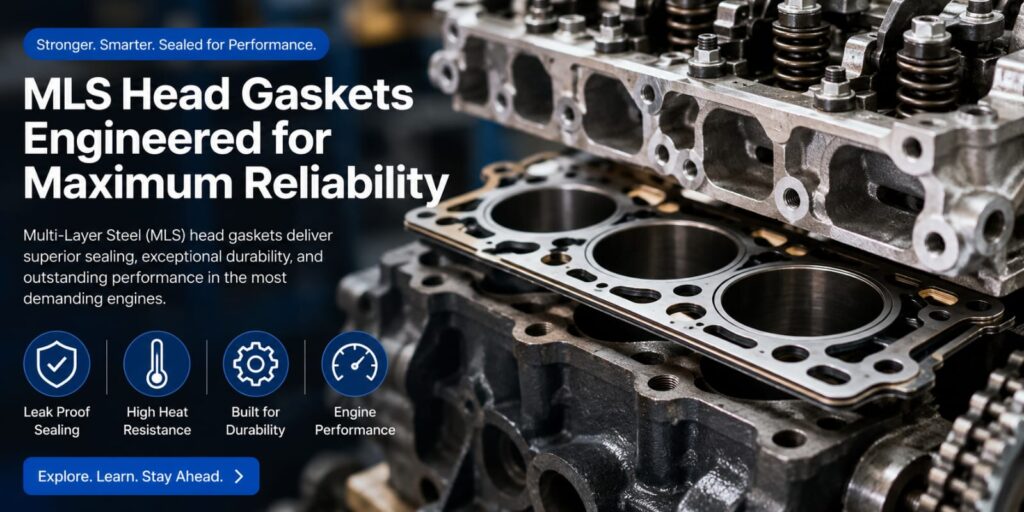
If you’ve ever popped the hood after seeing white smoke rolling out of your exhaust, or you’re simply trying to understand what keeps your engine’s cylinders sealed under extreme heat and pressure, you’ve probably run into the term “MLS head gasket.”
MLS stands for Multi-Layer Steel, and today it’s the standard gasket material used in the overwhelming majority of modern passenger vehicles, light trucks, and even many performance and racing applications.
This page is your starting point. Below, you’ll find a complete overview of what MLS head gaskets are, how they’re built, which brands make them, how they’re installed, what failure looks like, how much replacement costs, and how to troubleshoot a suspected gasket problem. Each section below is a short summary — for the full, in-depth breakdown of any topic, follow the linked guide.
What Is a Multi-Layer Steel (MLS)
Head Gasket?
A head gasket is one of the hardest-working components in your engine, even though most drivers never think about it until something goes wrong. It sits directly between the cylinder head and the engine block, and its job is deceptively simple to describe but extremely difficult to engineer: seal the combustion chamber so that compression, combustion gases, coolant, and oil all stay exactly where they’re supposed to be.
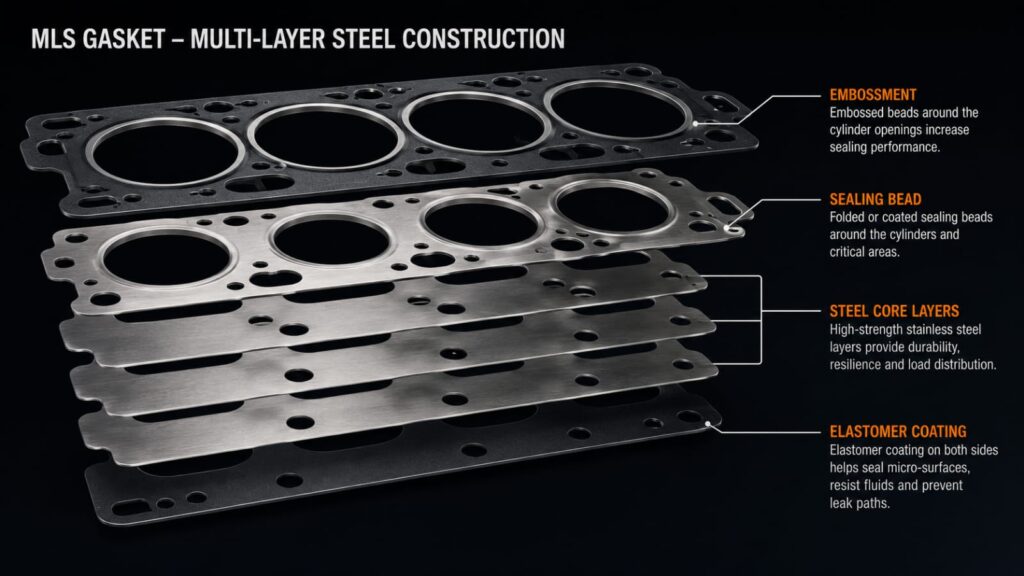
A Multi-Layer Steel gasket does this using several thin layers of spring steel — usually three to seven, depending on the engine — stacked together and coated with a thin rubber-like sealing material (commonly Viton or a nitrile-based elastomer). Each steel layer is precision-stamped with raised “embossments,” small ridges that act like springs around the cylinder bores, coolant passages, and oil passages. When the cylinder head is torqued down, these embossments compress slightly and create a tight, even seal across the entire gasket surface, even as metal expands and contracts with heat.
This is fundamentally different from older composite or graphite gaskets, which relied on a single thick layer of fiber, graphite, or asbestos-based material compressed between the head and block. Composite gaskets worked reasonably well for older, lower compression engines, but they had a real weakness: they could only compress so much before losing their seal, and they didn’t handle the repeated heating and cooling cycles of modern, higher-compression, turbocharged engines nearly as well.
Why Manufacturers Switched to MLS
- Steel layers flex and recover their shape thousands of times without losing sealing pressure, unlike composite material which compresses permanently over time.
- MLS gaskets handle much higher cylinder pressures, which matters for turbocharged and direct-injection engines that run hotter and unde more boost than older naturally aspirated designs.
- They’re thinner overall, which helps maintain consistent compression ratios — important for emissions compliance and fuel efficiency.
- They tolerate the dissimilar metals used in modern engines (aluminum heads paired with iron or aluminum blocks) far better, since the steel layers can flex independently to accommodate the different expansion rates of each metal.
For a deeper, side-by-side breakdown of composite, graphite, and MLS gasket materials, including which one suits which engine type, see our full High Performance Head Gaskets guide. And if you’re wondering exactly how many gaskets a typical car actually has — beyond just the head gasket — that’s covered there too.
MLS Head Gasket Brands and
Manufacturers
Not all MLS gaskets are made the same way, and the brand you choose can matter just as much as the gasket type itself. Some manufacturers supply
original equipment (OE) gaskets directly to automakers, while others specialize in aftermarket replacement parts, performance upgrades, or budget friendly options for shops working on older vehicles.
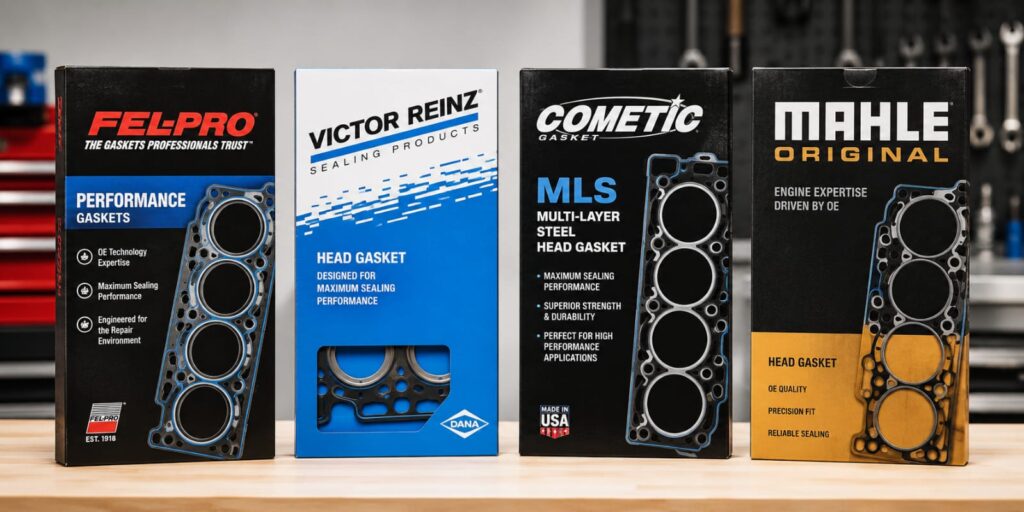
Some of the most recognized names in the industry include:
1.Felpro (Federal-Mogul) — One of the largest aftermarket gasket suppliers in North America, known for broad vehicle coverage and consistent quality at a mid-range price point.
2. Mahle — A major OE supplier to several automakers, often regarded as a premium choice because many of their gaskets are built to the
exact same spec used on the factory assembly line.
3. Victor Reinz — A German manufacturer with strong OE relationships, particularly popular for European makes.
4. Cometic — Widely used in performance and racing builds because they offer custom thicknesses, bore sizes, and layer counts that aren’t available in standard retail packaging.
5. Fel-Pro PermaTorque and similar “one-step” lines — designed to eliminate the need for a separate retorque procedure after the first heat cycle, which simplifies installation for DIY mechanics.
When two brands make a gasket for the “same” vehicle, the difference often comes down to layer count, embossment design, and the elastomer coating quality — details that affect long-term durability more than most buyers realize.
It’s worth understanding the practical difference between buying OE versus aftermarket in real-world terms, not just on paper. An OE-branded gasket (or one made by the same supplier that builds for the automaker, sold under their own name) typically costs more, but you’re paying for a part built to the exact tolerance the engineer who designed your engine specified — useful peace of mind on an engine with a known history of head gasket issues. A quality aftermarket gasket from a brand like Felpro, by contrast, is engineered to meet or exceed OE specifications but is mass-produced to fit a wider range of vehicles, which is why it’s usually more affordable and easier to find on short notice. For most daily-driven vehicles without a known gasket-failure history, a reputable aftermarket MLS gasket performs just as reliably as an OE part — the bigger risk to durability almost always comes from installation quality (surface prep, torque sequence, bolt condition)
rather than the brand printed on the box. Our full Automotive Gaskets guide covers how OE and aftermarket brands actually differ, and if you’re specifically deciding between two of the biggest names, our Mahle vs. Felpro gasket comparison breaks it down spec by spec.
How MLS Gaskets Are Built: Multi Layer Steel Construction Explained
Understanding the construction of an MLS gasket helps explain both why they’re so durable and why, when they do fail, the failure can look and behave differently than a failure in an older-style gasket.
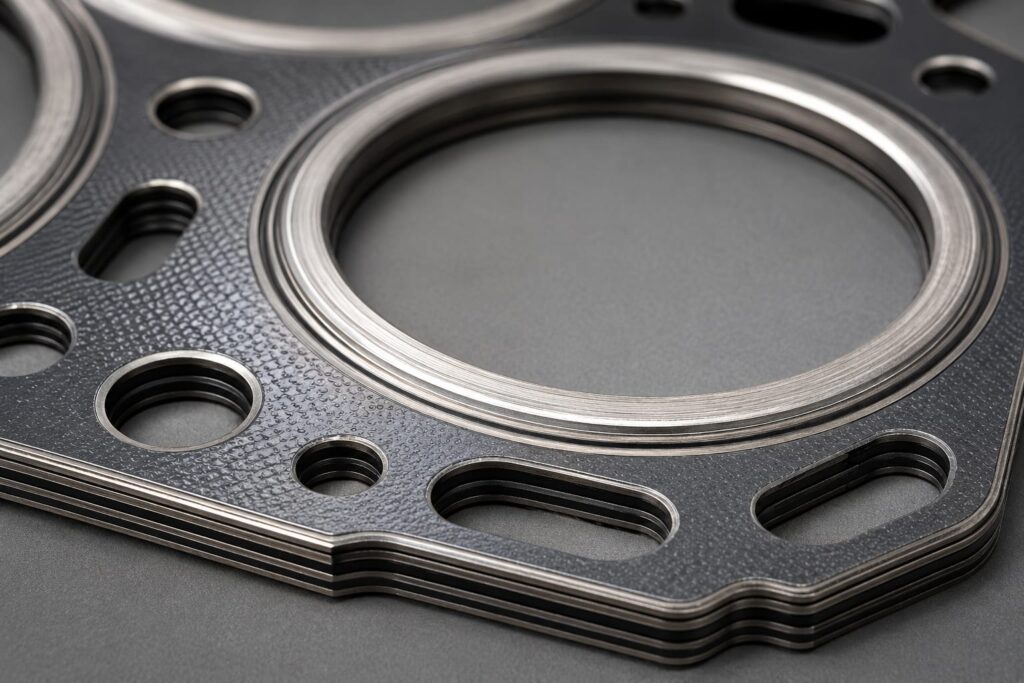
A typical MLS head gasket is built from individually stamped steel sheets, usually somewhere between 0.2mm and 0.3mm thick per layer. Around each cylinder bore, the steel is stamped into a raised bead — this is the embossment — which acts as a small, precisely engineered spring. When the head bolts or studs are torqued to spec, this bead compresses just enough to seal combustion pressure inside the cylinder without crushing flat, which means it keeps sealing properly even after tens of thousands of heat cycles.
The outer layers are typically coated with a thin elastomer (rubber-like) coating that fills in microscopic surface imperfections on the cylinder
head and block deck — imperfections that are invisible to the eye but large enough, at a microscopic level, to let combustion gases or coolant leak past a bare steel surface. Between the embossed steel layers, a middle “core” layer (sometimes called a spacer layer) sets the overall thickness of the gasket and helps distribute clamping load evenly.
Around the coolant and oil passages, the embossments are typically shallower than around the cylinder bores, since coolant and oil pressure is far
lower than combustion pressure — but the seal still has to be reliable, since even a slow coolant or oil leak through the gasket can cause serious engine damage over time
This is also where sealants come into the picture. While most modern MLS gaskets are designed to be installed dry — meaning no additional sealant is needed because the elastomer coating already does that job — some applications, repairs, or specific engine designs benefit from an additional liquid
sealant applied to specific areas, particularly on engines with known weak points around certain coolant passages. Our Multi Layer Steel guide covers
the full layer-by-layer construction in more depth, and the Gasket and Sealant page explains exactly when — and when not — to add sealant on top of an MLS gasket.
How MLS Head Gaskets Are Installed
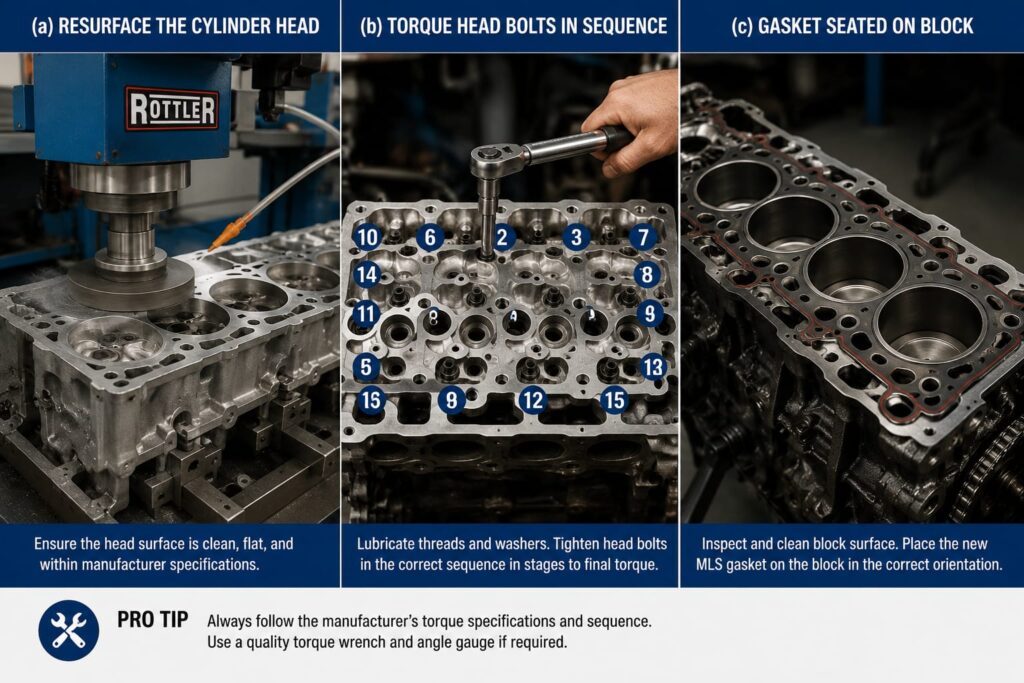
Installing an MLS head gasket correctly is just as important as choosing the right one. Even a high quality gasket will fail prematurely if it’s installed on a warped or improperly resurfaced cylinder head, or if the head bolts aren’t torqued in the correct sequence and to the correct specification.
The general installation process looks like this:
- Inspect and resurface the mating surfaces. Both the cylinder head and the block deck need to be
flat, typically within a few thousandths of an inch across their length, or the gasket cannot seal evenly. A cylinder head resurfacing machine is used to mill the head flat if it’s warped from overheating. - Clean both surfaces thoroughly. Any leftover gasket material, oil residue, or coolant film will prevent a proper seal, even with a brand-new gasket.
- Check whether sealant is needed. Most MLS gaskets are installed dry, but always check the manufacturer’s instructions — some specific engines or repair situations call for sealant in targeted spots.
- Position the gasket correctly. MLS gaskets are usually directional — they have a “this side up” marking — and the embossments need to face the correct direction relative to the cylinder head.
- Torque the head bolts in the proper sequence, typically working from the center outward in a spiral pattern, and in the specified number of stages (often three stages, ending at the final torque-to-yield angle for many modern engines).
- Follow any retorque or break-in procedure specified by the manufacturer, particularly for gaskets that aren’t a “one-step” design.
Two additional products that come up often in this context are head gasket sealers like K-Seal and Steel Seal — but it’s important to understand these are stopgap chemical repair products poured into the cooling system, not a substitute for proper gasket replacement. They can temporarily seal small leaks in some cases, but they are not a long-term fix for a genuinely blown head gasket. For the complete installation walk through, including how a cylinder head resurfacing machine works, the resurfacing stone hand-tool alternative, and a full step-by-step guide to installing cylinder heads, see our How to Use Head Gasket Sealer guide.
Signs and Symptoms of a Failing
MLS Head Gasket

This is, by far, the topic people search for most urgently — usually because they’re already seeing a warning sign and trying to figure out how serious it is. A failing head gasket can show up in several different ways depending on exactly where the seal has broken down.
Common Symptoms of a Failing Head Gasket
1.White or blue-white smoke from the exhaust — usually a sign that coolant is leaking into the combustion chamber and burning off along with the fuel.
2.Milky, off-white residue on the oil dipstick or under the oil cap — coolant mixing with engine oil creates a thick, milkshake-like substance. This is one of the clearest signs of a head gasket problem and is searched constantly by people checking their dipstick after noticing other symptoms.
3.Overheating, especially under load — when combustion gases leak into the cooling system, they create bubbles and pressure that interfere with proper coolant flow, often causing the temperature gauge to climb steadily or spike unexpectedly.
4.Bubbles in the coolant reservoir while the engine is running, particularly noticeable when revving the engine with the radiator cap off (a classic diagnostic test, though it should be done carefully).
5.Loss of coolant with no visible external leak — if coolant keeps disappearing and there’s no puddle under the car, it’s very likely going somewhere internally, most often past the head gasket and into a cylinder or the oil. 6.Rough idle or misfire, especially on a specific cylinder, since coolant or combustion gas leaking into a cylinder disrupts the combustion process.
7.Sweet smell from the exhaust — burning coolant has a distinct sweet smell, different from burning oil.
A common point of confusion is whether a car can still run, or even run “fine,” with a blown head gasket —
and exactly how long you can safely drive on one depends heavily on which symptom you’re seeing. The honest answer is: sometimes, for a while —
particularly with a small leak that hasn’t yet caused major coolant loss or contamination. But running on a known bad head gasket is risky, since it can progress from a minor leak to a complete failure, warped cylinder head, or even a cracked block fairly quickly, especially if the car overheats even once.
What Causes a Head Gasket to Fail?
Head gaskets typically fail due to chronic overheating, a defective gasket from the factory, improper installation (wrong torque sequence, warped surfaces), age and heat-cycle fatigue, or in some cases a poorly executed coolant system repair — including aftermarket chemical sealants where, in
some situations, products like Waterlock can actually contribute to a head gasket blowing rather than fix it.
For the full visual diagnostic breakdown — what a blown head gasket actually looks like, whether it causes overheating or the other way around, how to tell signs of a cracked cylinder head, what coolant contaminated oil actually looks like, the difference in exhaust smoke color and smell, and broader failing engine symptoms — see our complete Blown Head Gasket guide.
Maintaining Your MLS Head Gasket for Long-Term Reliability
An MLS head gasket is built to last, but it isn’t maintenance-free. Staying ahead of small issues — checking coolant levels regularly, watching for early warning signs of wear, following the correct torque and inspection intervals, and knowing when a repair or resurfacing might be needed before a full failure occurs — can add years to your engine’s life and help you avoid a much costlier repair down the road. For the complete maintenance checklist, inspection schedule, and preventive care tips, see our full MLS Gasket Maintenance and Care guide.
MLS Head Gasket Replacement:
What to Expect
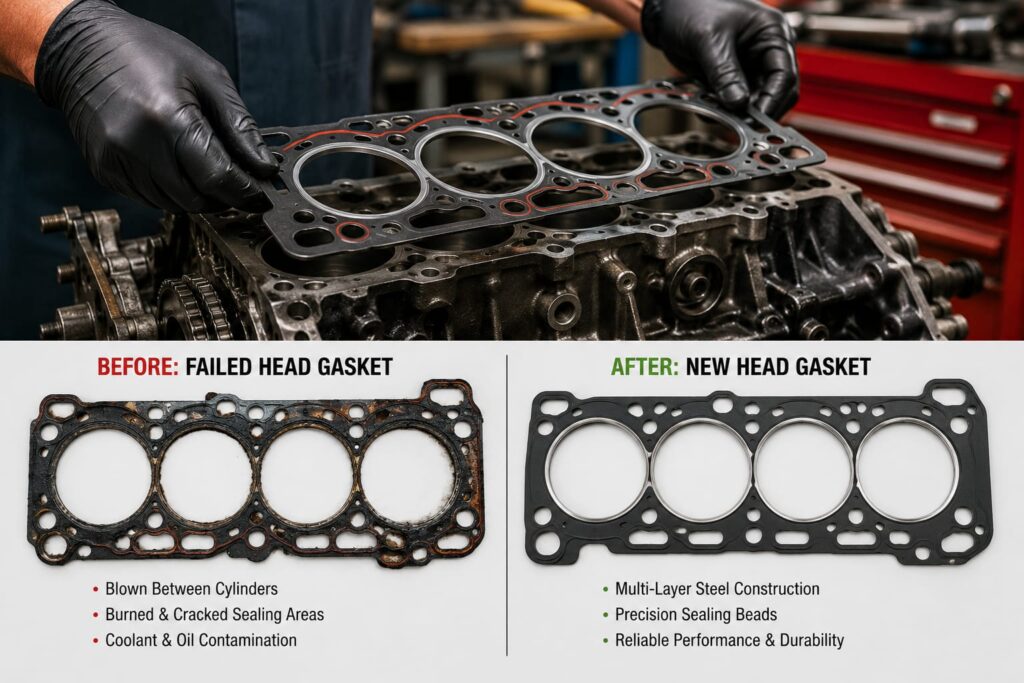
Once a head gasket has actually failed, replacement isn’t optional — it’s one of the few engine repairs that genuinely can’t be safely delayed, since continuing to drive on a blown gasket risks turning a moderate repair into a full engine replacement.
What’s Involved in a Head Gasket Replacement
Unlike many repairs, replacing a head gasket isn’t quick, because the cylinder head has to come off entirely, which means disconnecting the intake
manifold, exhaust manifold, valve cover, timing belt or chain, and all associated sensors, hoses, and wiring — then reversing the entire process on re-installation. This is why labor cost typically makes up the majority of a head gasket repair bill rather than parts cost.
Typical Cost Factors
1.Labor hours, which vary enormously by engine layout. A simple inline-4 engine might take 6–10 hours; a V6 or V8 with the engine mounted transversely (sideways) in a tight engine bay can take significantly longer, sometimes 15+ hours.
2.Parts beyond the gasket itself — head bolts often need to be replaced (many are torque-to-yield, single-use bolts), along with the cylinder head if it’s warped or cracked, plus a new coolant, oil, and oil filter, and often new spark plugs while everything is already apart.
3.Vehicle-specific factors — certain platforms have a reputation for being especially labor-intensive or prone to repeat failures, which is reflected in higher typical repair quotes for those specific models.
It’s a fair question to ask whether a blown head gasket is even worth fixing on an older or higher mileage vehicle — sometimes the repair cost approaches or exceeds the value of the car itself, in which case the decision becomes more about the rest of the vehicle’s condition than the gasket alone. For the full pricing breakdown — including how long the repair actually takes by engine type, model-specific guides for Subaru, Jeep, and diesel engines, plus detailed head replacement cost, gasket cover replacement cost, and valve gasket replacement cost figures — see our full Head Gasket Repair guide.
Troubleshooting a Suspected Head Gasket Problem
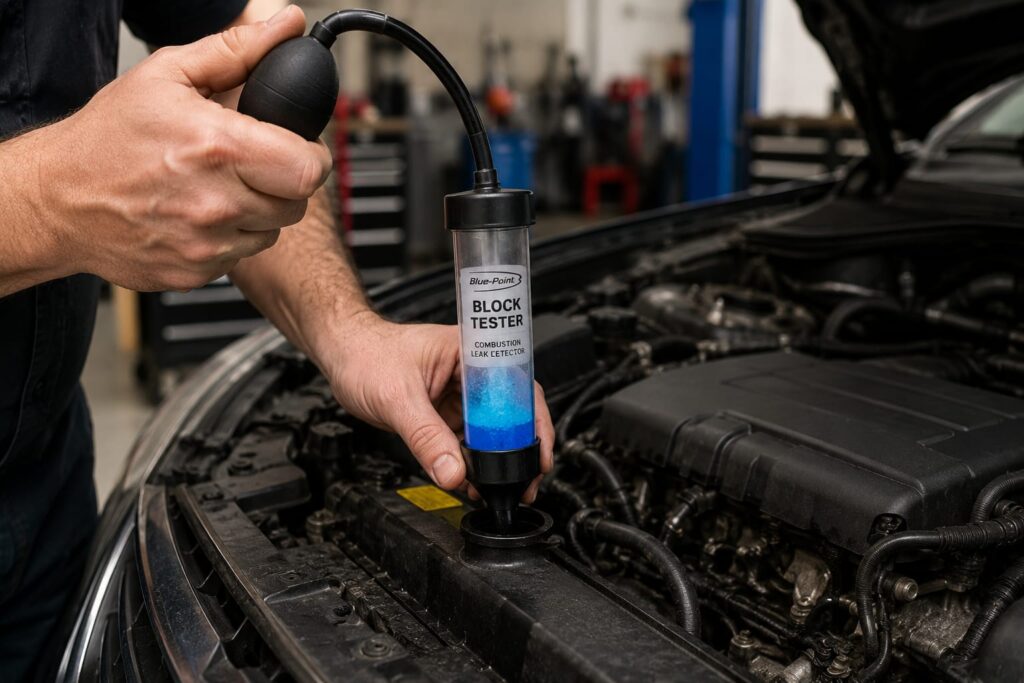
Before committing to a full repair, most mechanics — and most DIY owners — want to confirm the diagnosis first, since several of the symptoms above can overlap with other engine problems. Several testing methods are commonly used:
Chemical block testers, which detect combustion gases (specifically CO2) in the coolant by changing color when exposed to exhaust gas — a strong indicator that combustion gas is leaking into the cooling system through the gasket.
Cooling system pressure tests, which pressurize the system and check for a slow loss of pressure, indicating a leak somewhere — though this doesn’t always pinpoint the head gasket specifically versus a hose or radiator leak.
Visual inspection of the oil and coolant for crosscontamination, as described in the symptoms section above.
Compression testing, which can reveal unusually low or uneven compression between cylinders, particularly if a gasket failure has compromised the seal between two adjacent cylinders.
Combustion leak detection via the dipstick or oil f ill cap, watching for bubbling or excessive crankcase pressure
For the complete, step-by-step version of this process — including how to read block-test results correctly and why head gasket tests sometimes come back inconclusive — see our full How to Test for a Blown Head Gasket guide. One thing worth knowing before you test: no single method is 100% conclusive on its own. A chemical block tester can occasionally give a false negative on a very small leak, while a pressure test might miss a leak that only opens up once the engine reaches full operating temperature. For that reason, most experienced mechanics combine at least two of these methods — typically a visual/dipstick check alongside either a block test ora pressure test — before confirming a diagnosis and moving forward with a repair quote.
Why Multi-Layer Steel Became the Industry Standard
It’s worth stepping back and asking why nearly every automaker moved to MLS gaskets over the past two decades. The honest answer is that engines themselves changed faster than older gasket materials could keep up with. Turbocharging became common even in everyday economy cars, compression ratios climbed in pursuit of fuel efficiency, and engine blocks increasingly mixed aluminum and iron in ways that put more stress on the gasket than older, simpler engines ever did.
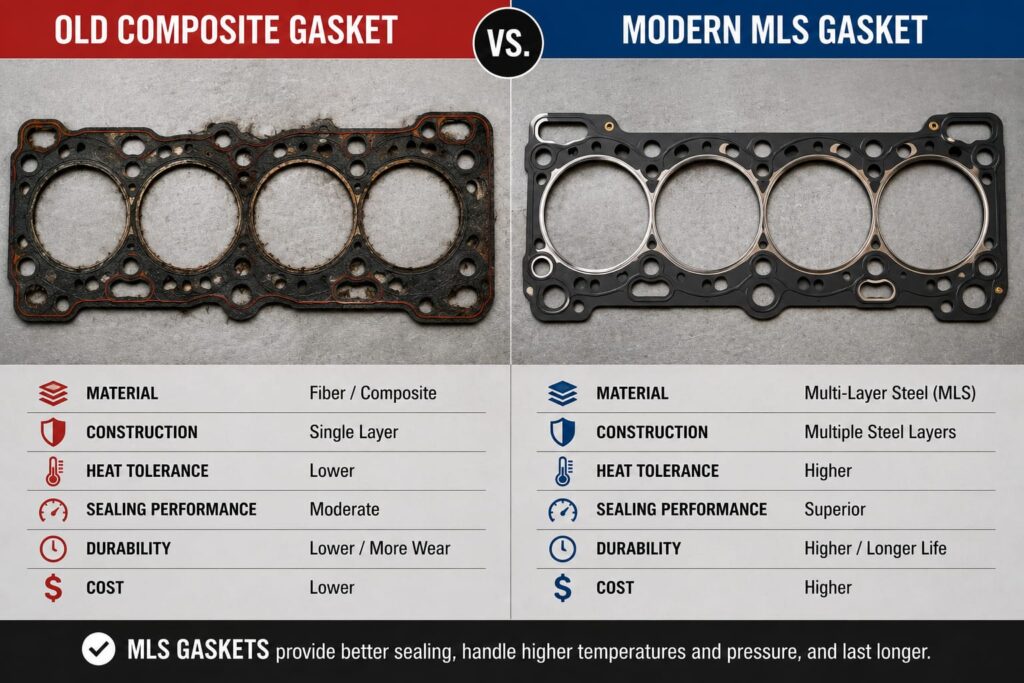
Composite gaskets simply weren’t engineered for that environment. They could seal a 1990s naturally aspirated engine reliably for well over 100,000 miles, but asked to handle a modern turbocharged directinjection engine running higher cylinder pressures and tighter emissions tolerances, they started failing farsooner than automakers, or owners, found acceptable.
MLS gaskets solved this by replacing a single compressible layer with multiple thin steel layers that f lex elastically rather than compress permanently. That single engineering shift is the reason head gasket failure, while still a real and serious problem, has become significantly less common as a percentage of overall engine failures since MLS gaskets became standard equipment industry-wide in the early-to-mid 2000s.
There’s also a manufacturing-cost angle worth understanding, since it explains why even budgetfocused automakers adopted MLS rather than sticking with cheaper composite materials. Stamped steel layers are actually very consistent and inexpensive to mass-produce once the tooling is set up, and because they don’t degrade the same way composite material does, automakers save money long-term on warranty claims tied to gasket failure. For consumers, this means an MLS gasket bought today, whether OE or a quality aftermarket brand, is generally a more reliable long-term investment than older-style materials ever were, even if the upfront price is occasionally a few dollars higher.
A Note on Performance and Racing Applications
While most of this page focuses on everyday passenger vehicles, MLS technology is also the dominant choice in performance and motorsport builds, for a slightly different reason: customization. Because the steel layers are stamped rather than molded, manufacturers like Cometic can produce MLS gaskets in custom bore sizes, custom thicknesses (to fine-tune compression ratio), and custom layer counts (to handle extreme boost levels) without redesigning an entire composite material formulation. This flexibility is part of why MLS gaskets show up just as often in a turbocharged track car as they do in a daily-driven commuter sedan — the underlying technology scales from mild to extreme far more easily than older gasket materials ever could.
Frequently Asked Questions
What is an MLS (Multi-Layer Steel) head gasket?
An MLS head gasket is a modern engine sealing component built from multiple thin layers of stainless steel — typically two to five — stacked together instead of using a single-material composite sheet. Each layer is coated with a thin rubber or elastomer coating that helps it seal microscopic imperfections on the cylinder head and block surfaces. Most vehicles manufactured after the early 2000s use MLS gaskets as standard equipment because they handle higher combustion pressures, resist heat cycling, and last significantly longer than older composite or graphite gaskets.
What is the difference between an MLS gasket and a traditional composite gasket?
The core difference is material and construction. A composite gasket uses a single layer of graphite, fiber, or asbestos-substitute material sandwiched between thin metal facings, which compresses over time and can lose its seal. An MLS gasket instead uses multiple thin steel layers with rubber coatings that flex and rebound with engine expansion and contraction, so it maintains consistent clamping pressure across many heat cycles. This makes MLS gaskets more durable under higher horsepower, turbocharging, and repeated thermal stress, which is why most factory engines have shifted to this design.
How long does an MLS head gasket typically last?
Under normal driving conditions and proper installation, an MLS head gasket can last well beyond 100,000 miles, and in many engines it will outlast the vehicle itself if the cooling system is maintained properly. Lifespan depends heavily on factors like coolant maintenance, avoiding chronic overheating, correct torque during installation, and the quality of the gasket itself. Aftermarket or low-quality MLS gaskets tend to fail earlier than OEM or reputable branded versions.
How much does it cost to replace an MLS head gasket?
Parts alone for an MLS head gasket typically range from a modest cost for common four-cylinder engines to a higher cost for V6 or V8 configurations, since larger engines need bigger gaskets and often two gaskets for a V-shaped layout. Labor is usually the larger expense because head gasket replacement requires removing the cylinder head, which is a time-intensive job. Total repair cost — parts and labor combined — commonly falls into a mid-to-high range depending on the vehicle, region, and whether any additional damage such as a warped head is discovered during the repair.
How can I tell if my head gasket has blown?
Common warning signs include white or milky engine oil (a sign coolant is mixing with oil), coolant loss with no visible external leak, white smoke from the exhaust, overheating without an obvious cause, and bubbling in the coolant reservoir or radiator. A more definitive test involves a chemical block test or pressure test of the cooling system, which a mechanic can perform to confirm combustion gases are entering the coolant passages. Catching these symptoms early can prevent more expensive engine damage.
Can I install an MLS head gasket myself, or should I hire a mechanic?
Installing an MLS head gasket is a major mechanical job that involves removing the cylinder head, resurfacing checks, precise torque sequencing, and often replacing related components like head bolts. Experienced DIY mechanics with the right tools and torque specifications can complete it, but any mistake in surface preparation or torque sequence can cause immediate gasket failure. For most vehicle owners, having a qualified mechanic perform the installation is the safer and more reliable option, especially since warranty coverage on the gasket often depends on correct installation.
Where to Go Next
This homepage gives you the full picture of MLS head gaskets — what they are, how they’re made, who makes them, how they’re installed, what failure looks like, what replacement costs, and how to test for a problem before committing to a repair. If you’re here because you’re already seeing symptoms, start with the Blown Head Gasket guide above. If you’re researching a repair or installation, start with Head Gasket Repair or How to Use Head Gasket Sealer. If you’re simply trying to understand the part itself, the Multi Layer Steel and High-Performance Head Gaskets guides are the best starting point.