
Once you’ve accepted that the repair is happening, the next practical question is almost always about time — specifically, how many days you’ll be without your car. Unlike a brake job or an oil change, this isn’t something you can wait around for at the shop. Knowing the realistic timeline up front helps you plan transportation and avoid being surprised partway through.
This post is part of our complete guide on head gasket repair costs and timelines — see the full breakdown for all repair scenarios below.
“complete head gasket repair guide”
The Short Answer
Most head gasket replacements take between one and four days from drop-off to pickup. The exact number depends heavily on your specific engine, whether the cylinder head needs machine work, and how busy the shop is with other vehicles. A simple inline-4 engine with no complications can sometimes be done in a single long day, while a V6, V8, or boxer engine with a warped head can stretch closer to a full week when you factor in outsourced machining time.
Day-by-Day Breakdown of a Typical Repair
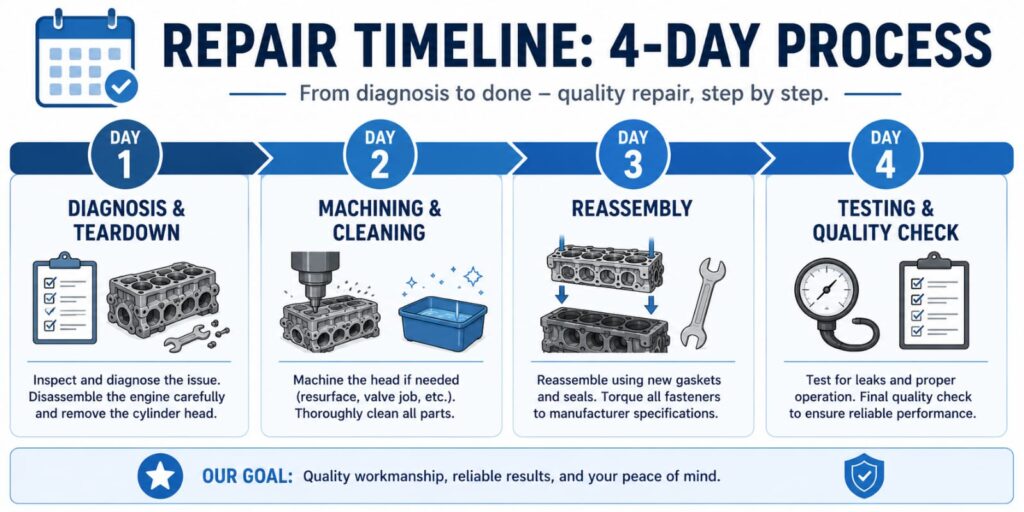
Day 1: Diagnosis and Teardown
The first day usually covers confirming the diagnosis (if it wasn’t already tested beforehand), then beginning the teardown — removing the intake manifold, exhaust components, timing belt or chain, valve covers, and finally the cylinder head itself. On more complex engines, this step alone can take most of the day.
Day 1-2: Inspection and Machining
Once the head is off, it gets inspected for warping using a straightedge and feeler gauge. If it’s within tolerance, it gets cleaned and prepped for reassembly. If it’s warped beyond spec, it typically needs to go to a machine shop for resurfacing, which is often outsourced and can add a day or more depending on how busy that shop is.
Day 2-3: Reassembly
With a clean, flat cylinder head and a new gasket in hand, the mechanic reassembles everything in reverse order, torquing the head bolts to the exact specification and sequence for your engine. This step requires patience and precision — rushing it is one of the most common causes of a repeat failure.
Day 3-4: Fluids, Bleeding, and Test Driving
The final stage involves refilling coolant and oil, bleeding air out of the cooling system (which can trap air pockets that cause overheating if not done properly), and test-driving the car through a full warm-up cycle to confirm there are no leaks or new symptoms before handing it back to you.
What Makes the Job Take Longer
- The cylinder head needs machining and has to be sent out to a separate machine shop
- The vehicle’s engine layout makes access difficult (transverse-mounted V6, Subaru boxer engines, etc.)
- The shop doesn’t have the gasket set or other parts in stock and has to special order them
- Additional damage is discovered mid-repair, such as a cracked head or damaged valve
- The shop is backed up with other vehicles ahead of yours in the queue
What Makes the Job Faster
- A simple inline-4 engine with straightforward access to the cylinder head
- The head passes inspection without needing machine work
- Parts are in stock and ready to go the same day
- The shop is not backed up and can dedicate a technician to the job continuously
Engine Type Makes a Bigger Difference Than You’d Think
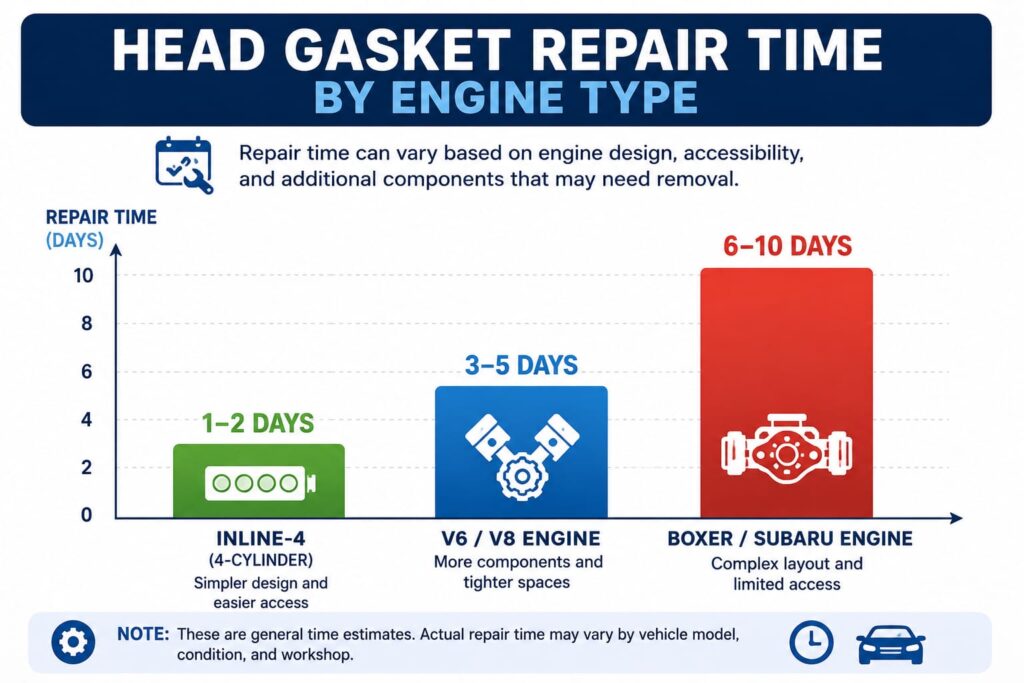
It’s easy to assume that timeline is mostly about how busy the shop is, but engine architecture plays just as big a role. A transverse-mounted V6 — common in many mid-size sedans and SUVs — often requires removing more surrounding components just to get clear access to the head bolts, compared to a longitudinally-mounted inline-4. Boxer engines, like those in Subarus, lay the cylinder heads horizontally on either side of the engine, which means there are two heads to deal with and less vertical clearance to work in, both of which add time.
| Engine Type | Typical Timeline |
| Simple inline-4, no machining needed | 1-2 days |
| Inline-4 or V6 with head machining required | 2-4 days |
| V6/V8 transverse-mounted, complex access | 3-5 days |
| Boxer engine (Subaru) — both heads affected | 3-6 days |
These ranges are general guidance, not guarantees — always confirm the expected timeline with your specific shop, since shop workload varies week to week.
Should You Rent a Car or Ask for a Loaner?
Given that most realistic timelines run at least 2-3 days, it’s worth arranging alternate transportation before you drop the car off rather than assuming you’ll have it back the same afternoon. Some shops offer loaner vehicles, especially dealership service departments, while independent shops may not. Ask this question when you book the appointment, not on the day you drop the car off, so you’re not scrambling for a ride home.
Red Flags: When a Fast Timeline Should Worry You
If a shop promises same-day turnaround on a job that normally requires machine work or a multi-hour teardown, it’s worth asking exactly what steps they’re skipping. A rushed head gasket job — particularly one that skips checking the head for warping, or doesn’t properly bleed the cooling system — is one of the more common reasons this repair has to be redone within months. A slightly longer, more careful repair is usually the better trade-off.
Frequently Asked Questions
Can a head gasket be replaced in one day?
On simple engines with no additional damage found, some shops can complete it in a single long day, but this isn’t the norm for most vehicles, especially if machining is needed.
Why did my shop say it would take a week?
A week-long estimate usually means either the shop is backed up with other work ahead of yours, or they’re waiting on parts or outsourced machining — not that the hands-on labor itself takes that long.
Is it bad if the shop finishes faster than expected?
Not necessarily, but it’s reasonable to ask whether the cylinder head was checked for warping and whether the cooling system was properly bled, since skipping these steps is how fast jobs sometimes turn into repeat failures.
Does the car need to sit or cool down after the repair?
Most shops test-drive the car through a full warm-up and cool-down cycle before returning it, specifically to catch any leaks or air pockets in the cooling system while it’s still on their lift, not yours.
[LINK: How to Test for a Blown Head Gasket -> confirm the diagnosis before repairing]