
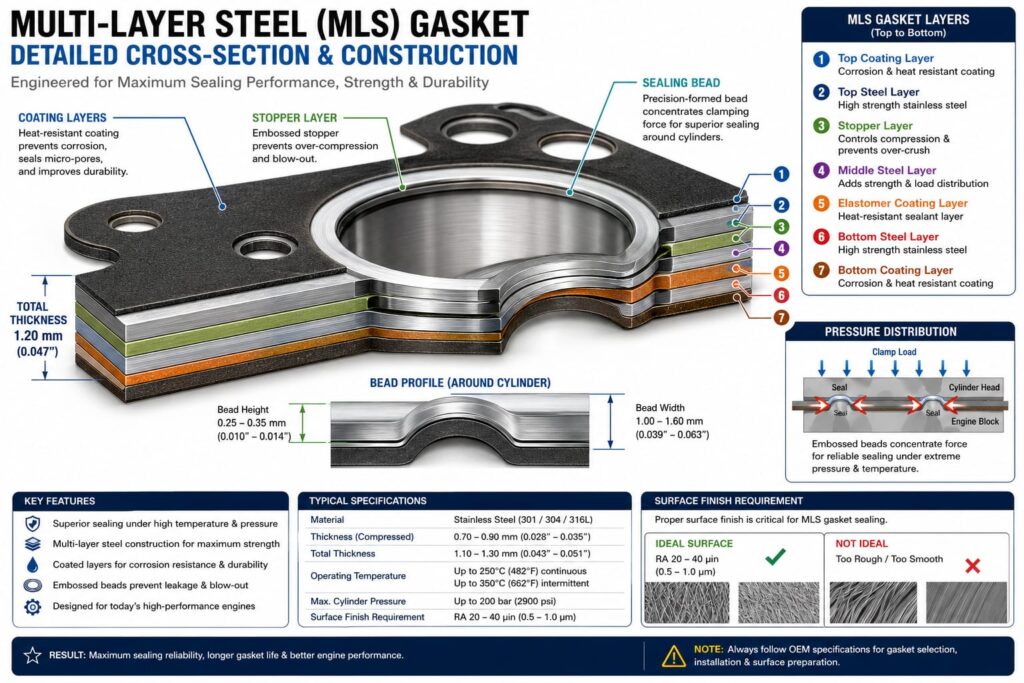
Behind every MLS head gasket lies decades of materials science, precision engineering, and real-world validation. The seemingly simple gasket sitting between your cylinder head and engine block is actually a sophisticated seal system, with every layer, coating, and bead profile precisely calculated to survive extreme combustion pressures and thermal cycling.
This technical deep-dive explores the complete MLS gasket construction story — from basic layer architecture through elastomer chemistry, thermal behavior, mechanical properties, and the engineering decisions that make one gasket suitable for a stock passenger car while another handles 500+ PSI peak combustion pressure in a professional race engine.
The Basic Three-Layer Architecture
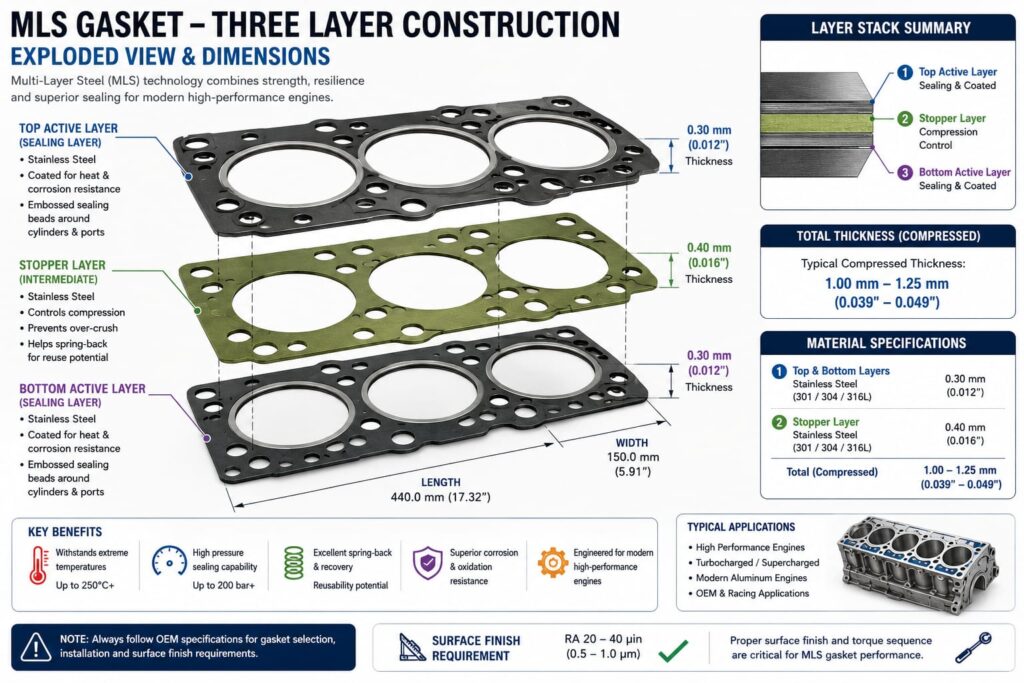
A standard MLS gasket consists of three fundamental components stacked in sequence:
1. Top Active Layer
The outermost sealing surface is a thin plate of spring steel (typically 0.2-0.3 mm thick) with an embossed bead pattern on its surface. The embossed beads are the primary sealing mechanism — when cylinder head bolts tighten, these beads compress against the machined surface of the cylinder head, creating a metal-to-metal seal that resists gas blow-by. The material must be spring steel, not rigid carbon steel, because the spring properties allow the bead to recover after compression.
2. Stopper Layer (Middle)
Between the active layers sits the stopper layer — a thicker steel plate (typically 0.3-0.8 mm) that controls how far the outer beads can compress. Think of it as a shock absorber for the sealing beads. Without a stopper layer, the beads would flatten completely under bolt load, losing their spring-back capability and the permanent sealing force that keeps the gasket functional throughout the engine’s operating life. The stopper layer is a critical design element that distinguishes MLS gaskets from inferior single-layer designs.
3. Bottom Active Layer
The bottom surface uses an identical spring steel layer and bead pattern as the top, providing symmetric sealing on both the cylinder head and engine block surfaces. Modern MLS gaskets are fully reversible — either side can face up during installation.
Heavy-Duty & Racing Variants: 4-6 Layer Designs
Pressure demands for turbocharged and high-compression engines exceed what a three-layer design can reliably handle. Performance manufacturers respond by adding additional stopper layers:
- 4-Layer: One additional stopper layer for moderate boost (15-25 PSI)
- 5-Layer: Two stopper layers for high boost (25-35 PSI)
- 6-Layer: Three stopper layers for extreme boost and racing (35+ PSI)
Each additional layer increases sealing redundancy, allows finer control of clamp load distribution, and raises the maximum safe combustion pressure. However, there’s a trade-off: additional layers increase compressed thickness, which affects compression ratio. A racing engine builder might need to select 5-layer over 6-layer to hit the exact compression ratio specification.
Elastomer Coating Chemistry
All steel layers receive a coating of elastomer (synthetic rubber). This coating serves multiple critical functions:
Microscopic Gap Filling
Even “smooth” machined metal surfaces are microscopically rough. An elastomer coating fills these valleys (typically 0.025-0.1 mm thick), creating a continuous sealing surface that works on surfaces with minor imperfections.
Chemical Barrier
The elastomer resists attack from oil, coolant, combustion gases, and corrosive byproducts. Without coating, raw steel would corrode within hours of exposure to coolant.
Friction Control
Elastomer provides controlled friction between layers, reducing fretting wear and preventing internal layer movement.
Conformability
The rubber-like nature allows the gasket to conform to imperfect surfaces, important when assembling on worn or imperfectly machined components.
Elastomer Types & Temperature Ratings
- Nitrile (NBR): Budget option, continuous rating 120°C
- Fluoroelastomer (FKM/Viton): Standard premium, continuous rating 200°C+
- Proprietary Racing Coatings: Extreme temperature, specialty fuel compatibility
Bead Profile Engineering
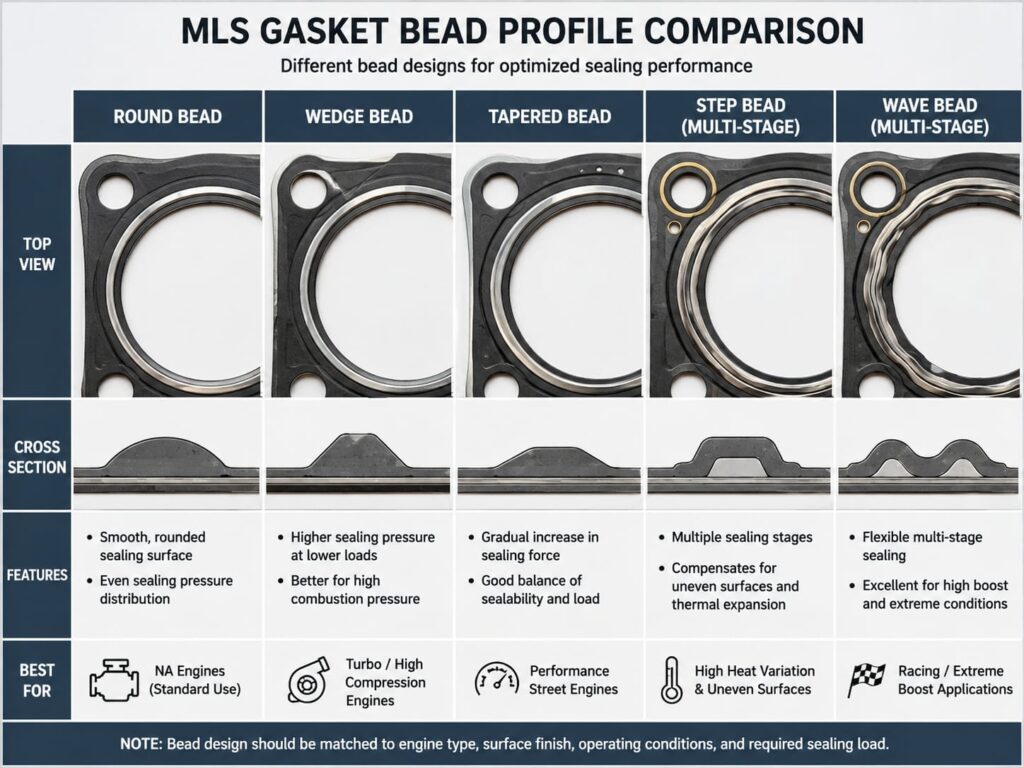
The embossed bead pattern on active layers is where MLS gasket engineering truly shines. The bead geometry is a carefully-designed compromise between sealing force and conformability:
Bead Height & Pitch
Higher beads generate more sealing force when compressed but require higher bolt torque to compress fully. Pitch (spacing between beads) is optimized based on the specific engine’s combustion chamber geometry and bolt circle diameter. A larger engine needs wider-pitched beads to cover larger surface area.
Bead Profile Shape
Different manufacturers use different profiles: round beads, wedge-shaped beads, or multi-stage compression profiles. Each shape is engineered for specific pressure distributions and thermal stress patterns in that engine application.
Radial vs. Circumferential Beads
Some gasket designs include both radial beads (pointing toward the combustion chamber center) and circumferential beads (around the combustion bore), creating multiple sealing points that provide redundancy.
Thermal Behavior Under Combustion
An MLS gasket must handle thermal shock — sudden temperature spikes from 25°C to 500°C+ during combustion, and back down during deceleration. Each layer has different thermal properties, creating complex expansion/contraction dynamics:
- Steel layers expand predictably with thermal load
- Elastomer coating expands differently, creating micro-movements within the gasket stack
- These movements are controlled by the stopper layer architecture
Poor design would cause the layers to separate or delaminate under thermal cycling. Modern MLS gaskets are engineered to handle 10,000+ thermal cycles (a typical engine’s operating life) without separation.
Surface Finish Requirements
MLS gaskets perform on properly prepared surfaces. Rough or warped surfaces cause failure. Typical requirements:
- Surface finish: Ra 0.8-1.6 microns (mirror-smooth)
- Flatness: Less than 0.05 mm warpage across entire surface
- Material: Iron or aluminum (both work with elastomer coating)
FAQ
Q: Why can’t I use single-layer steel gaskets?
A: Single-layer designs lack the stopper layer’s spring-back control. Under pressure, the layer flattens permanently, losing sealing force within days of operation.
Conclusion
Modern MLS gasket construction represents over 30 years of engineering refinement. Every layer, every coating chemistry, every bead profile serves a specific function. Understanding this construction helps you appreciate why quality gaskets cost what they do — and why cutting corners on gasket selection is false economy.
MLS Head Gasket Construction: Detailed Engineering & Analysis
Gasket and Sealant Guide: What’s the Difference & When to Use Each