
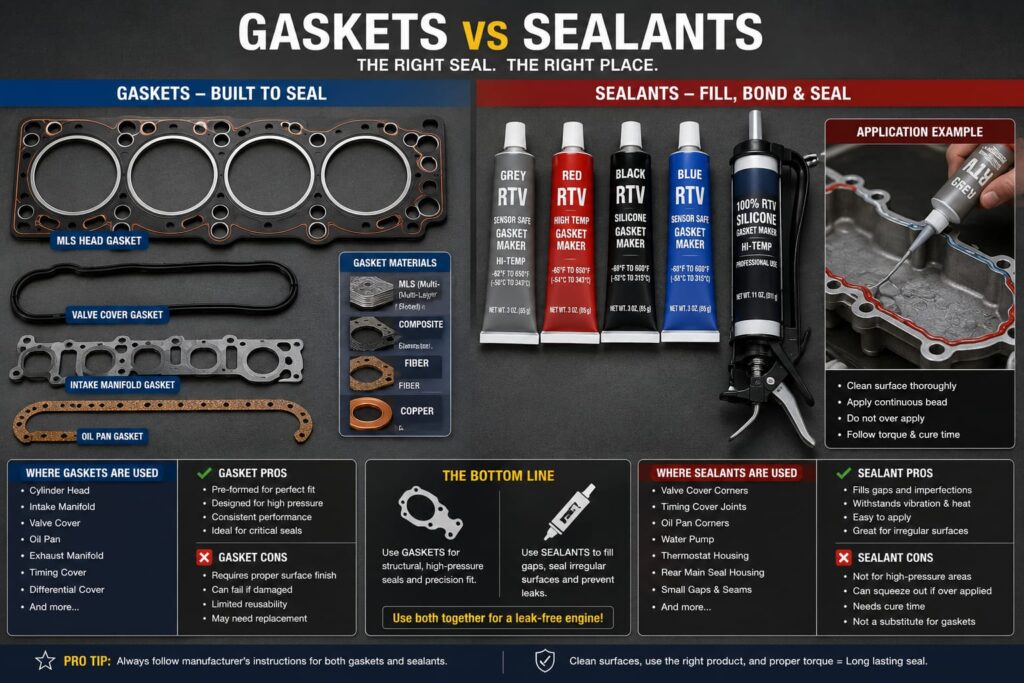
One of the most common misconceptions in automotive repair is that gaskets and sealants are interchangeable. They’re not. Each serves a specific function, and applying sealant to a surface that requires a gasket (or vice versa) is a recipe for leaks and disaster.
What Is a Gasket?
A gasket is a solid component — a finished part manufactured to specific dimensions and specifications. It fills the space between two mating surfaces, conforming to imperfections in the surfaces. Gaskets are designed to be single-use and are replaced during major repairs.
Examples: Head gasket, oil pan gasket, valve cover gasket, intake manifold gasket
What Is a Sealant (RTV)?
Sealant (typically RTV — Room Temperature Vulcanizing silicone) is a liquid or paste that cures into a rubber-like solid. It’s applied as a thin bead during assembly, fills gaps better than gaskets in some applications, and cures after parts are bolted together.
Examples: Oil pan sealant bead (some applications), transmission pan bead, thermostat housing
Critical Rule: Never Use Sealant on Head Gaskets
Modern MLS head gaskets are designed to be installed DRY — with no sealant, gasket maker, or spray. Applying sealant to an MLS gasket reduces sealing effectiveness, prevents proper bead compression, and can cause premature failure. Trust the gasket material itself — that’s exactly what it’s engineered for.
Exception: Some old composite gaskets required sealant. Modern MLS gaskets never do.
Where Sealants Are Appropriate
- Oil pan bead sealing (some applications)
- Transmission pan sealing
- Timing cover sealing
- Valve cover sealing on applications with severe surface wear
- Water pump housings
Always check the specific engine service manual for the manufacturer’s recommendation.
For head gasket specifications: [PILLAR LINK: Multi Layer Steel Construction Deep Dive]
Best Practices Summary
- ✓ Use proper-specification gaskets for all critical sealing points
- ✓ Follow manufacturer recommendations exactly (dry vs. with sealant)
- ✓ Use high-quality RTV sealant (Permatex, OEM equivalent) when sealant is specified
- ✓ Never improvise with inferior gasket materials
- ✗ Don’t apply sealant to modern MLS head gaskets
- ✗ Don’t skip gaskets where gaskets are specified
Conclusion
Gaskets and sealants serve different purposes. Modern MLS head gaskets are precision components that need no additional sealant. Respect the engineering, follow manufacturer specs, and you’ll have reliable sealing for the engine’s lifetime.