
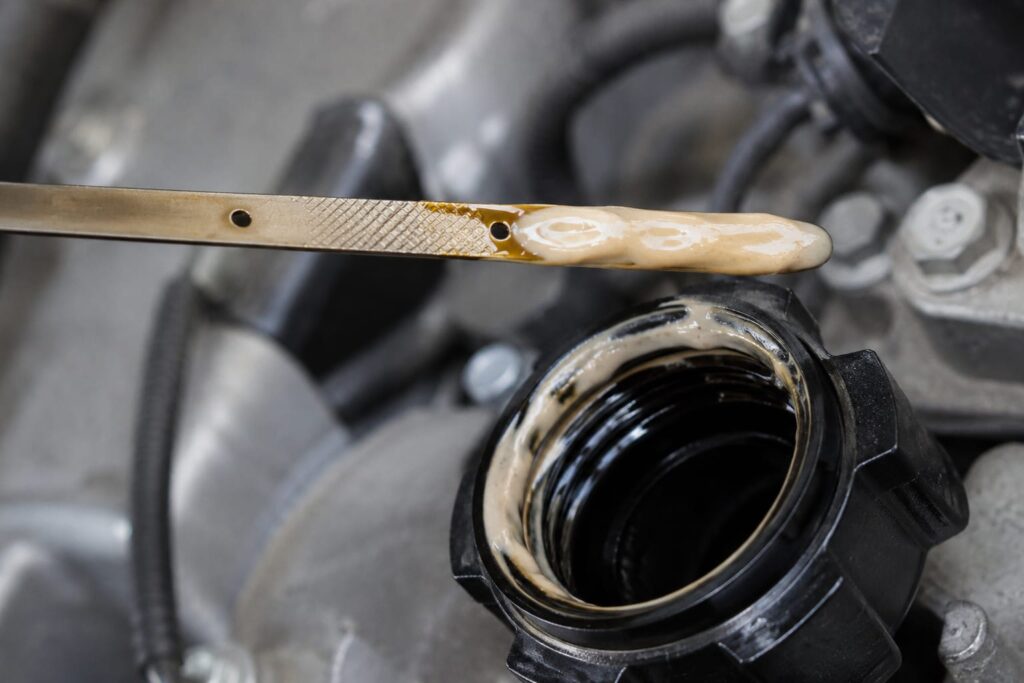
Pulling the dipstick and seeing something that looks more like a milkshake than motor oil is one of those moments that gets people’s attention fast. It’s a visual, unmistakable sign that something is wrong — and unlike a warning light, it doesn’t leave much room for wondering if it’s a false alarm. This guide covers what’s actually happening when oil turns milky, what causes it, and how to tell a real problem from a harmless one-off.
What the Milky Color Actually Is
Oil and coolant don’t mix the way water and dish soap do — instead, coolant getting into the crankcase creates a thick, pale emulsion that looks a bit like a milkshake or mayonnaise, sometimes with visible foam or froth. This texture is the biggest giveaway that you’re looking at coolant contamination rather than just old or dirty oil, which tends to darken rather than lighten.
What Causes Coolant to Get Into the Oil
A handful of failure points can let coolant cross into the oil passages:
A head gasket that has failed between a coolant passage and an oil passage is the most common cause, since the two systems often run close together inside the engine.
A cracked cylinder head or engine block can create a similar path even if the gasket itself is intact.
On some engines, a failed oil cooler — a component that uses coolant to regulate oil temperature — can leak internally and mix the two fluids without any gasket or head damage involved at all.
A cracked intake manifold, less commonly, can also allow crossover between coolant and oil passages depending on the engine layout.
Is It Always a Serious Problem?
Not every trace of discoloration means a major failure. A thin film of light, slightly cloudy residue can sometimes show up from ordinary condensation, especially on cars that mostly do short trips in cold weather and rarely get a full warm-up drive. That kind of moisture buildup is usually a much thinner film than true coolant contamination and often clears up after a longer highway drive that lets the engine fully burn off the moisture.
The distinction that matters is thickness and persistence. A thick, mayonnaise-like consistency that doesn’t clear up after a proper warm drive, or that keeps coming back, points to an actual coolant leak rather than condensation.
Why Coolant in the Oil Is Dangerous to Ignore
Oil’s job is to keep metal surfaces inside the engine separated by a thin lubricating film. Coolant mixed into that oil breaks down its lubricating properties, which means moving parts — bearings, camshaft lobes, cylinder walls — start experiencing more friction and wear than they’re designed for. Driving for an extended period on contaminated oil can turn a gasket repair into a much larger engine repair, since worn bearings and damaged internals aren’t fixed by simply replacing the gasket.
Other Symptoms Worth Checking Alongside It
Milky oil rarely shows up in complete isolation when a head gasket is the cause. It’s worth also checking for white or blue-white exhaust smoke, a rising temperature gauge, coolant that keeps disappearing with no visible leak, or bubbling in the coolant reservoir with the cap off and the engine idling.
What to Do Next
If the discoloration is thick and doesn’t clear up after a proper drive, avoid extended driving until it’s diagnosed. A mechanic can pinpoint whether the source is the head gasket, the oil cooler, or a cracked component using a combination of a compression test, a block test, and a visual inspection — each points to a different repair, so it’s worth confirming before committing to parts and labor.
Full breakdown: see our Blown Head Gasket guide for the complete list of related symptoms, causes, and next steps.