
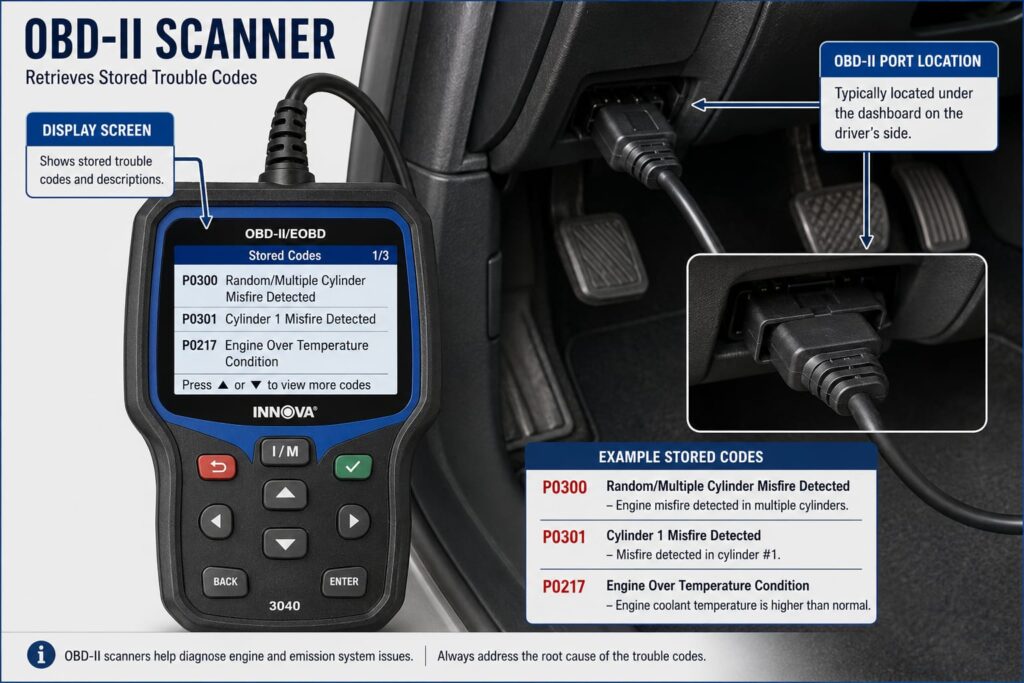
Modern vehicles (1996 and newer) have an onboard diagnostic system called OBD-II that monitors engine performance. When a head gasket fails, it triggers specific fault codes that an OBD-II scanner can read. While the scanner won’t directly say “head gasket failed,” the codes it reveals paint a clear diagnostic picture when interpreted correctly.
Why Head Gasket Failure Triggers Codes
A blown head gasket disrupts multiple engine systems: combustion imbalance, coolant temperature fluctuations, oxygen sensor confusion, and misfires. The OBD-II system detects these anomalies and stores fault codes. Different head gasket failures trigger different codes—some directly, others indirectly—but patterns emerge that point to gasket failure.
Types of OBD-II Scanners
• Basic Code Readers ($20-50): Display fault codes only. No live data.
• Mid-Range Scanners ($100-200): Read codes + show live data (temperature, pressure, voltage).
• Professional Scanners ($200-500+): Advanced diagnostics, bidirectional control, freeze frame data.
• Smartphone-Connected Scanners ($30-100): Use your phone as display. App-based interpretation.
Tools and Materials Needed
• OBD-II Scanner (appropriate to your vehicle)
• Vehicle with OBD-II Port (under dashboard, driver’s side)
• Engine Running or Key in ON Position
• Fault Code Reference Guide (app or printed)
• Notebook (to record codes)
Common Head Gasket Failure Codes
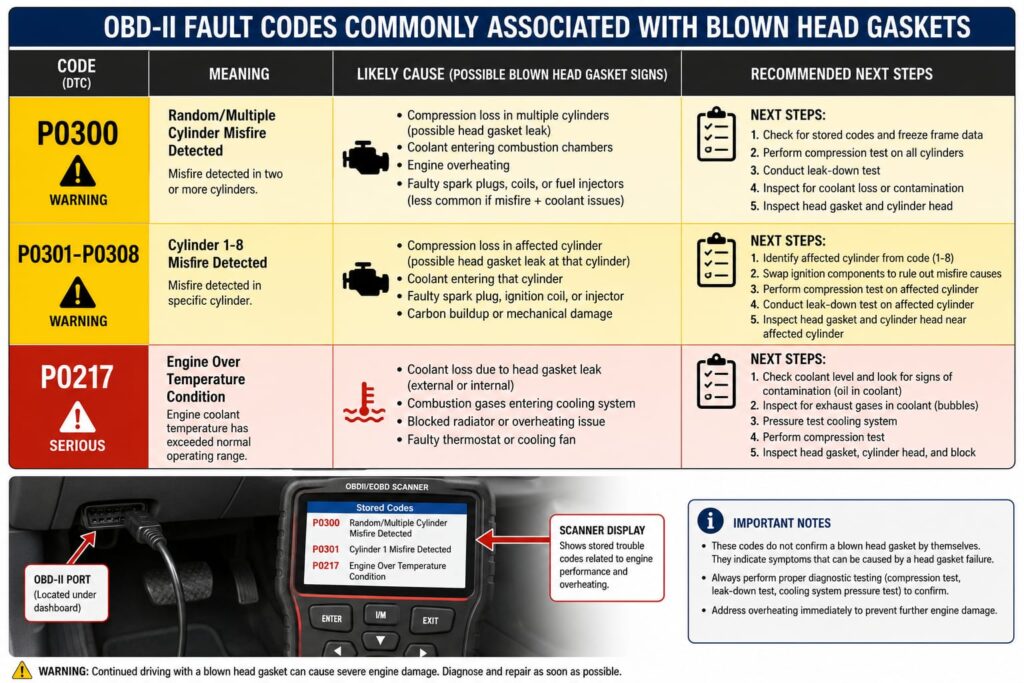
P0171 / P0174: System Too Lean – Combustion imbalance from gasket leak
P0300: Random Misfire Detected – Multiple cylinders misfiring
P0301-P0308: Cylinder-Specific Misfire – One cylinder misfiring (points to affected cylinder)
P0128: Coolant Temperature Regulation – Thermostat or cooling system malfunction
P0133: O2 Sensor Circuit Slow Response – Sensor confusion from combustion leak
P0505: Idle Air Control System Malfunction – Engine running rough
Step-by-Step Procedure
Step 1: Locate Your OBD-II Port
The OBD-II port is a 16-pin connector, usually located under the steering wheel on the driver’s side. Consult your owner’s manual if unsure.
Step 2: Connect Your Scanner
Plug your OBD-II scanner into the port. For wireless/Bluetooth scanners, ensure your phone app is open and connected. The scanner will power up automatically.
Step 3: Start Your Vehicle
Turn the ignition to ON (or start the engine, depending on scanner type). Allow 2-3 seconds for the scanner to initialize and communicate with your vehicle’s computer.
Step 4: Read Fault Codes
Navigate the scanner menu to “Read Codes” or “Retrieve DTCs” (Diagnostic Trouble Codes). Your scanner will display all stored codes and pending codes.
Step 5: Record All Codes
Write down every code displayed. Include whether each is a stored code (triggered in the past) or a pending code (currently active). Example format: P0300 (Stored), P0301 (Pending).
Step 6: Review Live Data (If Applicable)
If your scanner supports live data, view real-time readings: engine temperature, coolant temperature, fuel trim values, and misfire counts. Watch for abnormalities: rapid temperature swings, unusually high fuel trim adjustments, or frequent misfire events.
Step 7: Interpret Results
Use a fault code reference (many online databases are free) to understand what each code means. Look for patterns pointing to head gasket issues (misfires in specific cylinders, cooling anomalies, misfire combos).
What the Codes Suggest
No Codes: Either your head gasket is in early-stage failure (codes haven’t appeared yet) or the gasket is healthy.
Misfire Codes (P0300, P030X): Suggest combustion leak or compression loss. Correlate with compression test results.
Lean Codes (P0171, P0174): Excess oxygen detected. Possible gasket leak allowing air into combustion chamber.
Temperature Codes (P0128): Cooling system instability. Combined with other symptoms, suggests gasket failure.
Multiple Code Combinations: Multiple codes pointing to combustion/thermal issues = strong head gasket indicator.
Advantages of OBD-II Scanning
✅ Targeted Diagnostics: Points to specific problem cylinders or systems
✅ Cost-Effective: Entry-level scanners are $20-50
✅ Comprehensive Data: Live data shows multiple parameters simultaneously
✅ Professional-Grade: Mechanics rely on the same codes
✅ Quick Results: Codes appear instantly
✅ Reusable Tool: Scanner works for any future diagnostics
Limitations of This Test
❌ Codes Aren’t Specific: P0300 (Misfire) can have multiple causes
❌ Older Vehicles May Not Have Codes: Pre-1996 vehicles lack OBD-II
❌ Early-Stage Failure: Codes may not appear until gasket leak is significant
❌ Interpretation Complexity: Multiple codes require analysis to identify patterns
❌ Doesn’t Show Severity: Code presence confirms problem, not its extent
Cost and Time Estimate
Basic Code Reader: $20-50
Mid-Range Scanner: $100-200
Professional Scanner: $200-500+
Smartphone Scanner: $30-100
Time Required: 5-10 minutes
Recommended Scanners for Beginners
• Autel AP200 ($99): Great balance of features and price
• BlueDriver ($99): Smartphone-based, detailed code explanations
• Innova 3160RS ($60): Budget-friendly, reliable
• Veepeak OBDCheck BLE ($30): Ultra-affordable Bluetooth option
FAQ
Q: Will clearing codes make the head gasket problem go away?
A: No. Clearing codes only removes the light temporarily. If the gasket is blown, codes will reappear within days or weeks.
Q: Do I need an expensive scanner?
A: A basic $20-50 code reader is sufficient to detect head gasket-related codes. Professional shops use advanced scanners for detailed diagnostics, but DIY diagnosis doesn’t require expensive equipment.
Q: What if I get codes but no visible symptoms?
A: Codes can appear before obvious symptoms. This is actually beneficial—early detection prevents worse damage. Investigate the codes with a compression or pressure test.
Conclusion
OBD-II scanning is a powerful diagnostic tool that should be part of your head gasket investigation. While codes alone won’t tell you “your gasket is blown,” patterns of misfire codes, lean codes, and temperature anomalies create a compelling diagnostic picture. For modern vehicles (1996+), a basic scanner ($20-50) is invaluable. Combined with physical tests (oil inspection, pressure testing), OBD-II codes complete your diagnostic puzzle.
Use this with other methods for complete diagnosis! See the [PILLAR LINK: How to Test a Blown Head Gasket – Complete Guide] for comprehensive testing strategies.