
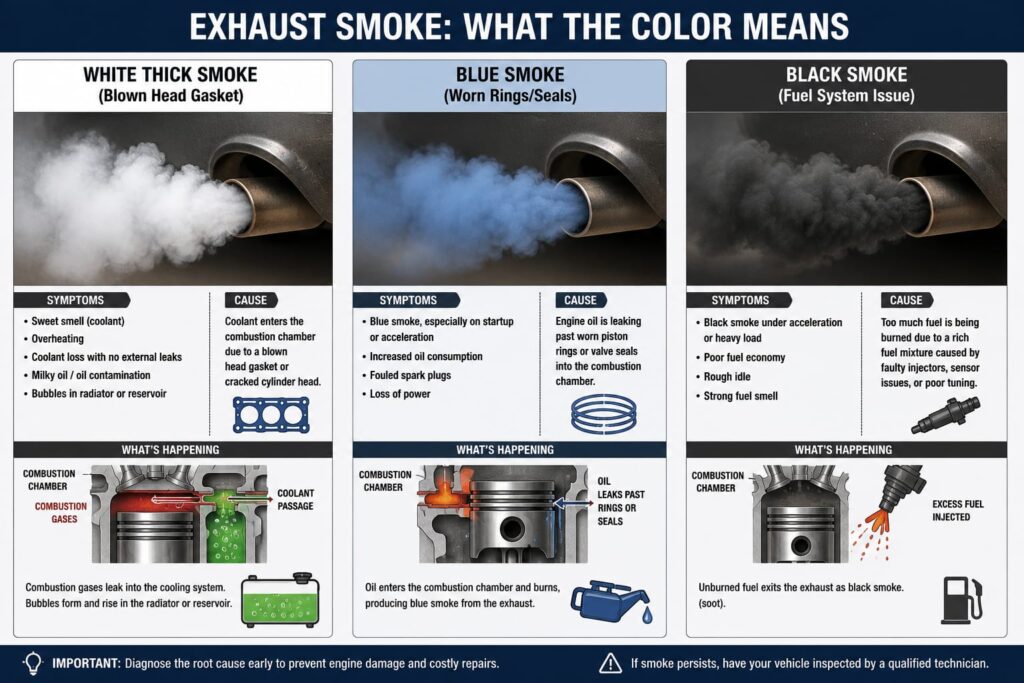
When coolant enters the combustion chamber through a blown head gasket, it burns along with the fuel. This creates a distinctive white, sweet-smelling exhaust smoke that’s one of the most obvious signs of head gasket failure. Unlike blue smoke (oil burn) or black smoke (rich fuel mixture), white exhaust smoke is nearly pathognomonic for coolant combustion.
Why Coolant Creates White Smoke
Engine coolant is primarily water-based. When water enters the combustion chamber and heats to extreme temperatures, it vaporizes into steam. This steam exits through the exhaust system, appearing as white smoke. The characteristic sweet smell comes from the glycol antifreeze component of the coolant.
Tools You’ll Need
• Safe Parking Area (with observer for safety)
• Helper or Passenger (to watch exhaust while you drive)
• Clear Day (overcast is better than cloudy for smoke visibility)
• Your Nose (to smell the distinctive sweet odor)
• Time (10-15 minutes)
Step-by-Step Procedure
Step 1: Warm Up Your Engine
Start your vehicle and let it idle for 2-3 minutes to reach normal operating temperature. Smoke may not be visible on a cold engine.
Step 2: Position Your Observer
Have someone safely stand 10-15 feet behind your vehicle, off to the side of the exhaust. They need a clear view of the tailpipe without inhaling fumes.
Step 3: Light Acceleration
Gently accelerate to 2,000-3,000 RPM and hold it for 5-10 seconds. Do this 2-3 times, allowing brief pauses between accelerations.
Step 4: Observe the Smoke Color
Your observer should watch carefully for smoke color. Have them note: Is the smoke white, blue, or black? How thick is it? Does it persist or quickly dissipate?
Step 5: Check the Smell
Carefully (and briefly) smell the exhaust. Coolant smoke has a distinctive sweet odor—almost like burnt candy or syrup. Oil burn produces a sharp, acrid smell. Rich fuel produces a gas smell.
Interpreting Your Observations
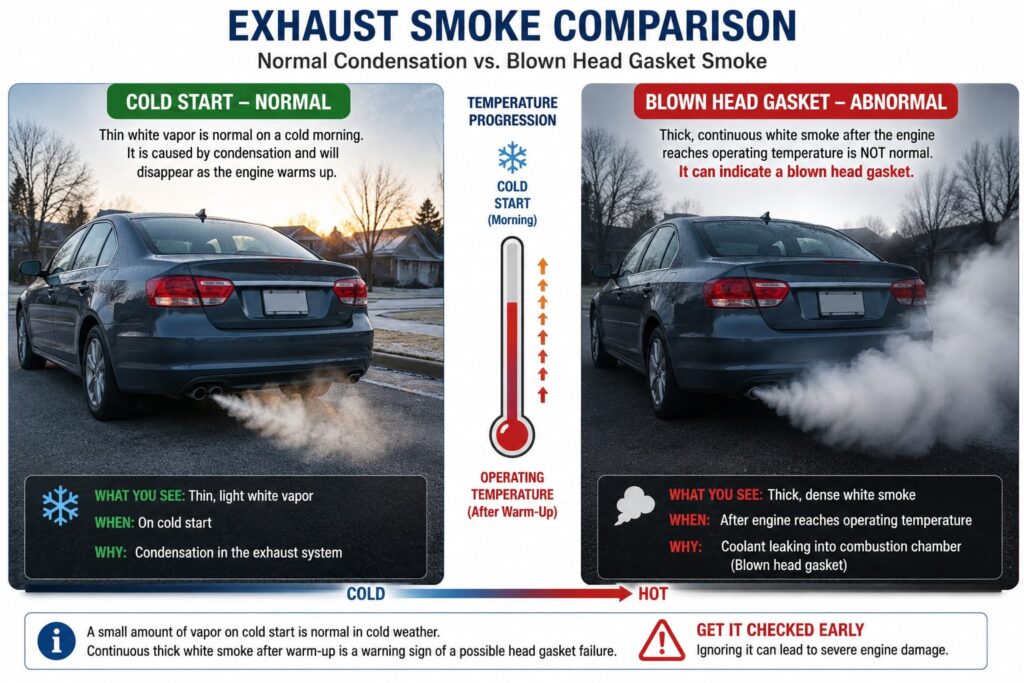
Normal Exhaust: Little to no visible smoke, especially on warm days. On cold mornings, brief white steam is normal.
Blue Smoke: Indicates oil burning. Not a head gasket issue (usually worn piston rings or valve seals).
Black Smoke: Too-rich fuel mixture. Engine tuning issue, not head gasket.
White Smoke (Persistent): If white smoke appears during acceleration and persists for several seconds, head gasket failure is likely.
Sweet Smell: Strong indicator of coolant. Combined with white smoke, this is nearly definitive.
Advantages of the Exhaust Smoke Test
✅ Free: No tools or equipment needed
✅ Quick: Performed during a short test drive
✅ Observable: The evidence is visible and detectable
✅ Safe: No mechanical work or coolant handling required
✅ Multi-sensory: You can see AND smell the problem
Limitations of This Test
❌ Weather Dependent: White smoke is harder to see in bright sunlight
❌ Can Mimic Other Issues: Some fuel system problems create white smoke
❌ Doesn’t Show Severity: Can’t measure how much coolant is leaking
❌ Not Definitive Alone: Should be combined with other tests
❌ Safety Concerns: Requires driving and having an observer
Cost and Time Estimate
Equipment Cost: $0 (free)
Time Required: 10-15 minutes
Overall Cost: Nothing
FAQ
Q: Is morning condensation the same as coolant smoke?
A: No. Morning white vapor quickly disappears and has no sweet smell. Coolant smoke persists and has a distinctive sweet aroma.
Q: Does this test work on cold engines?
A: Not effectively. Always warm the engine first to reach operating temperature.
Conclusion
The exhaust smoke test is a simple but powerful diagnostic tool. If you see persistent white smoke with a sweet smell, your vehicle almost certainly has a blown head gasket. Combine this test with other methods like the oil test or compression test for definitive confirmation before scheduling repairs.
Need more diagnostic options? Explore the [PILLAR LINK: How to Test a Blown Head Gasket – Complete Guide] for 5 additional tests.