
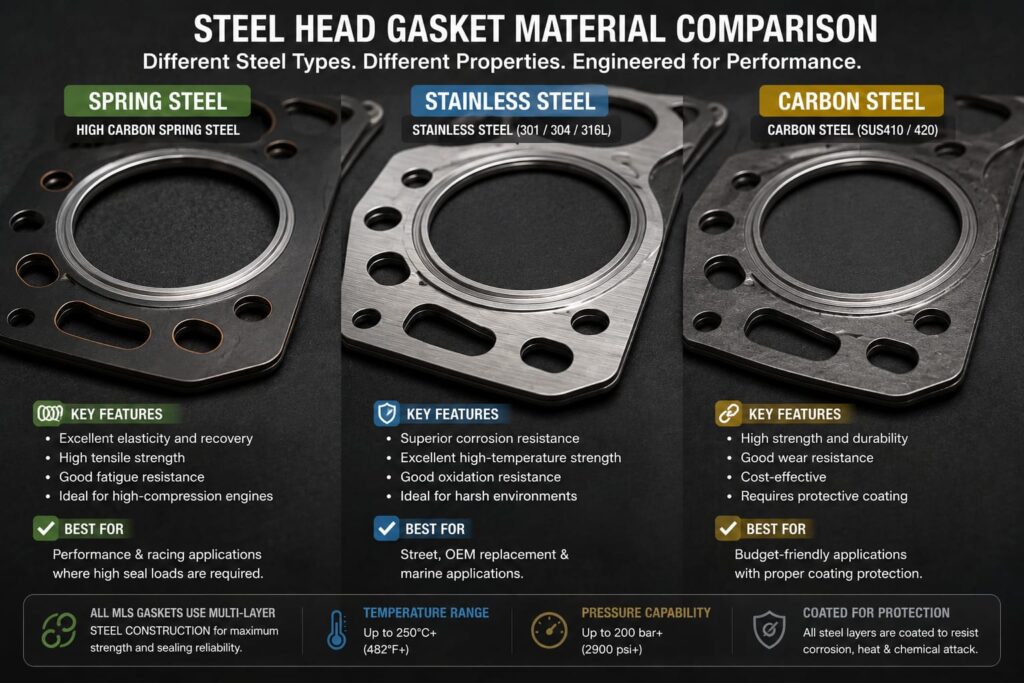
The choice between spring steel, stainless steel, and other steel alloys significantly impacts gasket performance, lifespan, and cost. Understanding the differences helps you select the right gasket for your specific engine application.
Spring Steel Gaskets — The Standard
Material: Low-carbon spring steel (ASTM 1095 or equivalent)
- Characteristics: Excellent spring-back properties, reliable compression recovery
- Temperature rating: Effective to 200°C+
- Cost: Budget-friendly, standard in OEM applications
- Best for: Daily drivers, stock engines, standard street cars
Why Spring Steel?
Spring steel’s high yield point and excellent spring-back characteristics make it ideal for gasket applications. Beads compress when head bolts tighten, then recover when the engine heats up, maintaining constant sealing pressure.
Stainless Steel Gaskets — Premium Performance
Material: 301 or 304 grade stainless steel
- Characteristics: Superior corrosion resistance, better high-temperature retention
- Temperature rating: Effective to 250°C+
- Cost: 15-30% premium over carbon steel
- Best for: Turbocharged engines, racing, methanol-injected builds, extreme applications
Stainless Advantages
Resists corrosion from racing fuel, methanol, and exhaust gases
- Maintains strength at extreme temperatures
- Longer service life in harsh conditions
- Preferred by professional racing teams
For material comparison: [PILLAR LINK: Head Gasket Material Guide]
Carbon Steel vs Spring Steel — Key Difference
Carbon Steel: Lower yield point, permanent deformation under high load, unsuitable for gaskets
- Spring Steel: High yield point, elastic recovery, ideal for gasket beads
Never use carbon steel where spring steel is specified.
Specialty Steel Alloys
Some racing manufacturers use proprietary steel alloys with exotic properties: higher yield strength, better fatigue resistance, or enhanced temperature stability. These are cutting-edge materials typically available only through specialty racing suppliers.
For racing gasket options: [PILLAR LINK: Multi Layer Steel Construction Deep Dive]
Material Selection Summary
- Stock engine → Spring steel (carbon steel MLS)
- Turbocharged street car → Stainless steel MLS
- High-boost racing → Stainless steel heavy-duty or specialty alloys
Conclusion
Steel remains the dominant gasket material in modern automotive engines due to its combination of performance and cost-effectiveness. Spring steel provides excellent value for standard applications, while stainless steel is worth the premium for high-stress environments.