
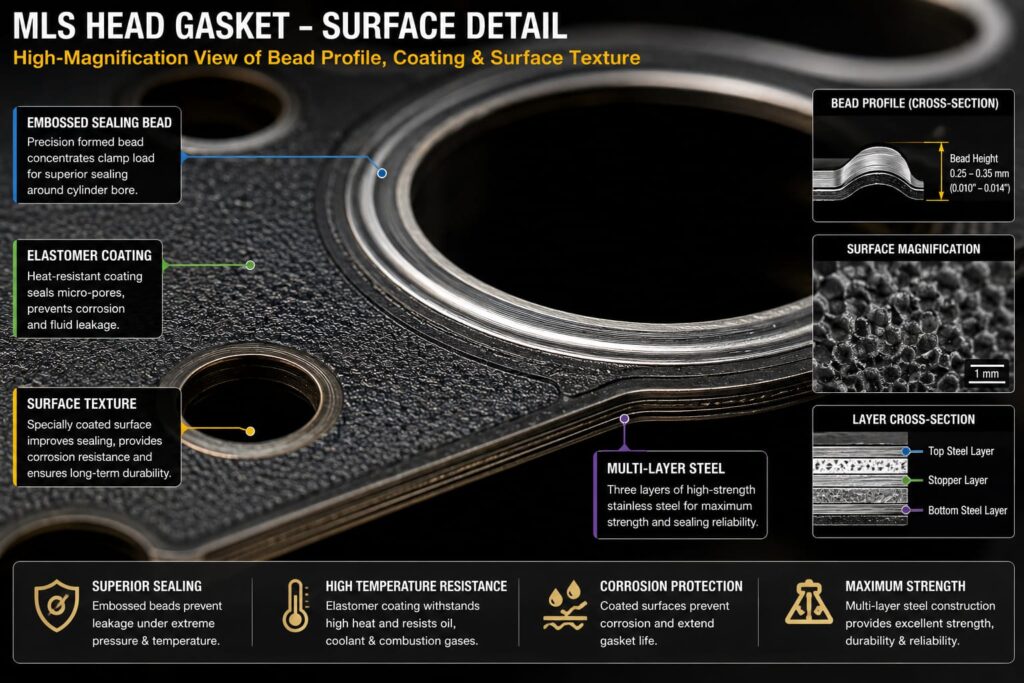
If you’ve ever wondered why your mechanic recommended a specific MLS gasket brand and type, or why different engines require different gasket specifications, the answer lies in the subtle details of construction: layer count, material grades, bead geometry, and coating chemistry. Every variable is engineered for that engine’s specific operating environment.
Standard 3-Layer MLS Construction
Material Specifications
- Top Active Layer: Spring steel (ASTM 1095 or equivalent), 0.2-0.3 mm thick
- Stopper Layer: Thicker spring steel plate, 0.3-0.5 mm thick
- Bottom Active Layer: Identical to top layer, spring steel, 0.2-0.3 mm
- All surfaces coated with elastomer: 0.025-0.1 mm thickness
Why Spring Steel?
Spring steel has a higher yield point than regular carbon steel and excellent spring-back properties. When compressed by head bolts, spring steel beads recover to near-original height, maintaining compression force throughout the engine’s operating life. Carbon steel would flatten and never recover.
Bead Profile & Sealing
The embossed beads on each active layer are the actual sealing mechanism. When the cylinder head is bolted down:
- Beads compress against the head and block surfaces
- Elastomer coating fills microscopic valleys
- Spring-back force maintains pressure continuously
- Multiple bead points create redundant seals
For deeper engineering analysis: [PILLAR LINK: Multi Layer Steel Construction Deep Dive]
Pressure Ratings
Standard 3-Layer: 200-250 PSI peak combustion pressure (safe to ~10 PSI boost)
- Heavy-Duty 5-Layer: 300-400 PSI (safe to ~25 PSI boost)
- Racing 6-Layer: 500+ PSI (racing/extreme applications)
Conclusion
Understanding MLS gasket construction helps explain performance differences between brands and types. [PILLAR LINK: Explore our complete Multi Layer Steel guide]