
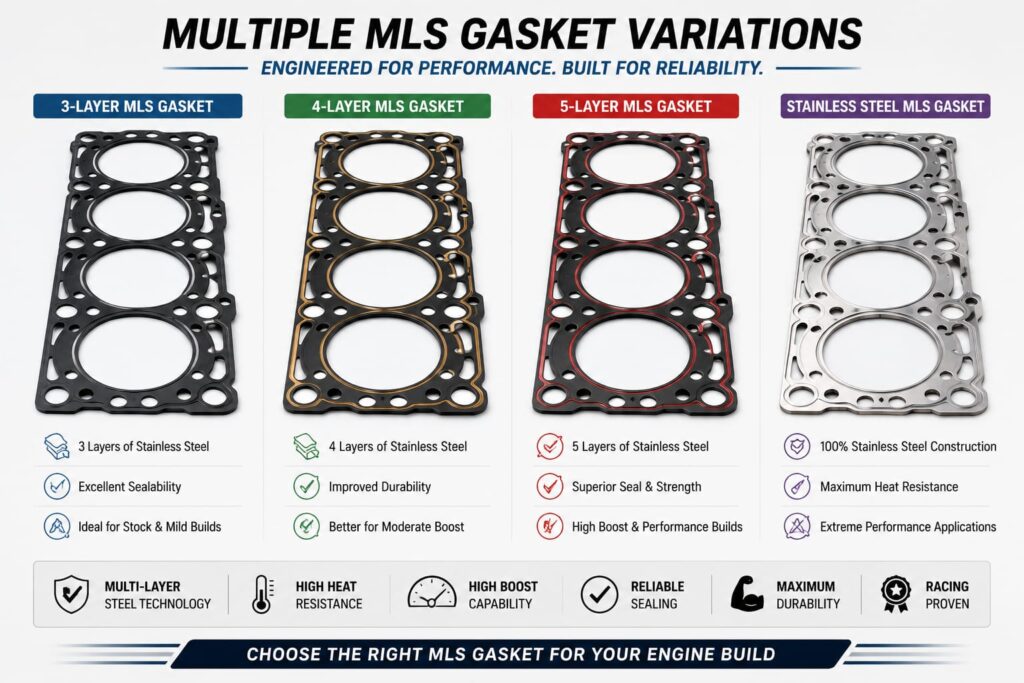
Not all MLS (Multi-Layer Steel) head gaskets are created equal. While the core multi-layer steel principle is consistent across the industry, variations in layer count, stopper layer thickness, elastomer coating chemistry, and base material (carbon steel vs. stainless steel) create different performance characteristics for different engine applications.
In this guide, we break down every MLS gasket variation — from standard OEM three-layer designs to extreme six-layer racing variants, single-vs-multi-layer options, and the specific material science that makes one gasket right for street engines and another ideal for boost.
The Three Core MLS Gasket Types
Standard 3-Layer MLS Gasket (OEM for Passenger Cars)
The workhorse of the automotive world. Three layers: two thin outer active layers with embossed sealing beads (typically 0.2-0.3mm each) and one middle stopper layer (0.2-0.5mm) that limits bead compression. All layers coated with elastomer (fluoroelastomer or nitrile).
Best for: Daily driver passenger cars, stock and mildly modified engines, zero-boost natural-aspiration applications.
Pressure rating: 150-200 PSI peak combustion pressure, safe to ~10 PSI boost.
Heavy-Duty 4-5 Layer MLS Gasket (Performance/Turbo)
Adds one or two additional stopper layers to handle higher clamp loads and boost pressures without bead flattening. Thicker stopper layer (0.3-0.8mm) maintains spring-back force. Used extensively in turbocharged OEM applications and high-performance street builds.
Best for: Turbocharged engines 10-25 PSI, high-compression modified builds, diesel engines
Pressure rating: 250-350 PSI, safe to ~25 PSI boost on engineered platforms.
Extreme Duty 6+ Layer Racing Gasket (Professional Racing)
Purpose-built for extreme conditions: multiple redundant stopper layers, ultra-premium elastomer coatings, custom bore sizing options, explicitly rated for specific boost pressures. Often custom-ordered with specifications matched to exact engine build.
Best for: Professional racing, drag racing, extreme turbo builds 25+ PSI, top-fuel applications
Pressure rating: 500+ PSI, ratings vary by specific design and manufacturer.
Learn more about high-performance gasket selection and boost ratings: [PILLAR LINK: High Performance Head Gaskets]
Material Composition: Steel Grades and Elastomer Coatings
Carbon Spring Steel vs. Stainless Steel Layers
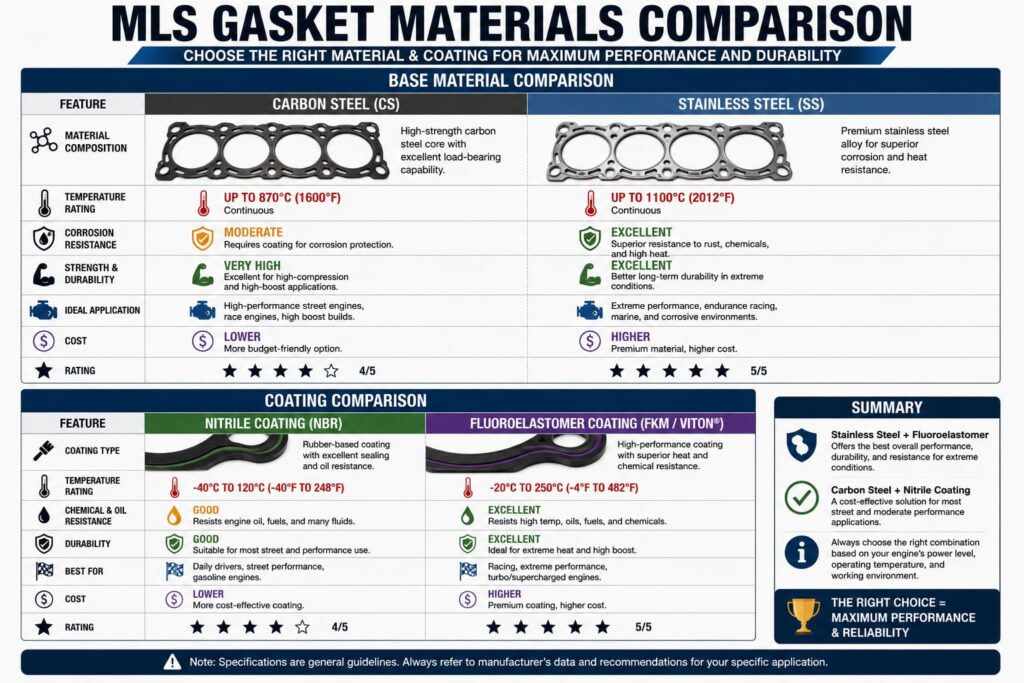
Most MLS gaskets use spring steel (low-carbon or ASTM 1095 type). This material provides excellent spring-back characteristics. Premium gaskets use 301 or 304 grade stainless steel, which offers superior corrosion resistance, higher temperature retention, and longer service life — especially important for forced-induction engines or applications with methanol injection and racing fuel.
Stainless MLS gaskets cost 15-30% more but deliver significantly better durability in extreme environments.
Elastomer Coating Types
The coating chemistry determines chemical compatibility and temperature capability:
- Nitrile (NBR) — Standard automotive grade, good to 120°C continuous
- Fluoroelastomer (FKM / Viton) — Premium grade, good to 200°C+, superior fuel/oil resistance
- Specialized Racing Coatings — Proprietary formulations (Cometic, Fel-Pro), optimized for methanol and extreme temps
Why MLS Materials Matter
Each material choice trades cost against performance. Carbon steel + nitrile is budget-friendly for OEM production. Stainless + fluoroelastomer suits performance. The right choice depends on your engine’s operating environment.
For a deeper look at high-performance gasket engineering: [PILLAR LINK: High Performance Head Gaskets]
FAQ
Q: What’s the difference between “multi-layer” and “multi-stage”?
A: Multi-layer refers to the physical layer stack. Multi-stage typically refers to the embossing pattern on active layers for sequential sealing. Both terms describe modern MLS technology.
Conclusion
Understanding MLS gasket types helps you make informed decisions for your specific engine application. Whether stock, slightly modified, or race-prepped, there’s an MLS gasket engineered for your needs. For complete high-performance gasket guidance, [PILLAR LINK: visit our High Performance Head Gaskets guide]