
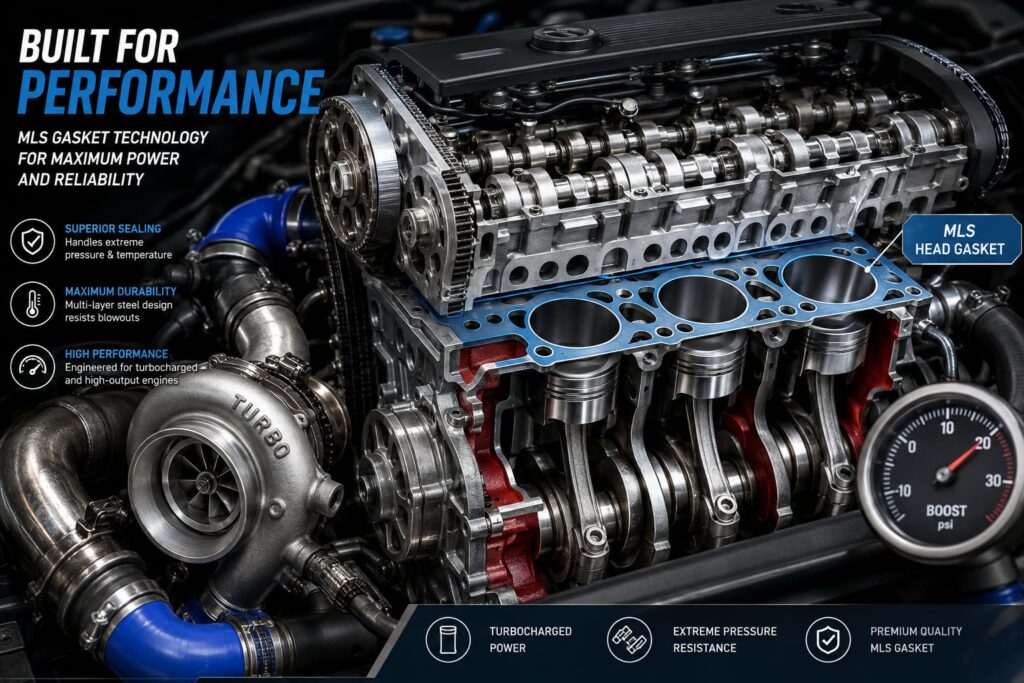
Modern performance engines push air, fuel, and combustion pressures to extremes that would destroy standard head gaskets in minutes. Whether you’re running a twin-turbo supercar, a nitrous-fed drag racer, or a high-boost street machine, selecting and installing the right high-performance MLS head gasket separates successful builds from catastrophic failures.
In this complete guide, we cover everything you need to know about high-performance head gaskets — from material science and construction differences, to comparing top racing brands, selecting gaskets for your specific boost level, installation best practices on modified engines, and troubleshooting gasket failures under extreme conditions.
Quick Navigation
- What Makes a Head Gasket ‘High Performance’?
- Multi-Layer Steel vs. Copper vs. Composite in Performance Applications
- Heavy-Duty MLS Gaskets for Turbocharged & Supercharged Engines
- Selecting Gaskets by Boost Level (Single Turbo, Twin-Turbo, Supercharger, Nitrous)
- Top Performance Head Gasket Brands & Manufacturers
- Installation Specifications for Modified Engines
- Common Failures Under Boost & Prevention
- FAQ
What Makes a Head Gasket ‘High Performance’?
A high-performance head gasket is specifically engineered to withstand cylinder pressures and thermal loads that exceed OEM specifications. Standard passenger car engines generate peak combustion pressures around 150-200 PSI. A turbocharged engine at 15 PSI boost generates 250+ PSI. A race engine on full boost with high octane fuel can exceed 500+ PSI — pressures that would instantly destroy a standard composite head gasket.
High-performance gaskets differ from OEM applications in:
- Thicker stopper layer — prevents bead flattening under extreme pressure
- Additional seal layers — 5 or even 6-layer designs for racing
- Premium elastomer coatings — superior high-temperature stability
- Tighter manufacturing tolerances — zero defect tolerance
- Multiple thickness options — allows tuners to adjust compression ratio
- Custom bore sizing — matches overbored or sleeved cylinders
- Designated boost ratings — gasket rated for specific pressure maximums
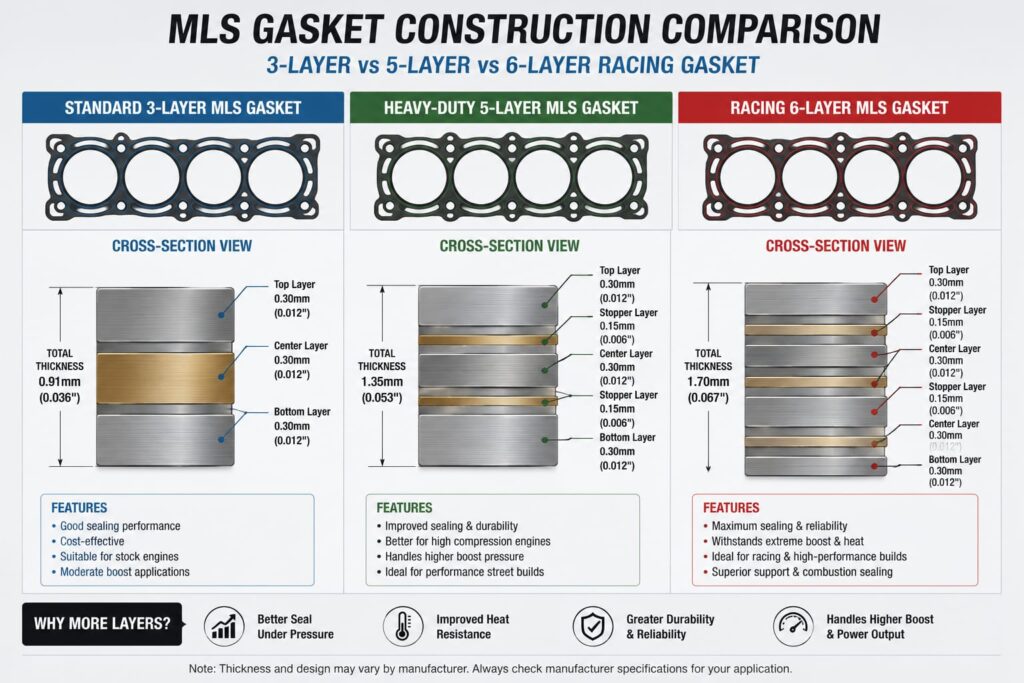
For deeper technical comparison of MLS, copper, and other materials in performance contexts, see our dedicated post: [PILLAR LINK: Head Gasket Material Guide]
Materials in High-Performance Applications
When building for boost, material selection becomes critical. Each material has its role in the performance world:
Multi-Layer Steel (MLS) for Boost
Modern MLS gaskets dominate performance engine building for good reason. Heavy-duty variants with 4-6 layers can reliably handle 20-30+ PSI of boost on street applications and extreme boost levels in controlled racing environments. Premium stainless steel MLS gaskets offer excellent corrosion resistance when paired with methanol injection or high-octane racing fuel.
Copper Gaskets in Racing
Solid copper and copper-shim head gaskets remain popular in professional racing due to their superior heat conductivity and reusability. Copper conducts heat away from the combustion chamber faster than MLS, reducing hot spots and detonation risk. However, copper gaskets require ultra-precise surface finishes and higher clamping loads. For street applications, the complexity typically doesn’t justify the cost difference — modern MLS is the better choice.
For complete material comparison and detailed engineering specs: [PILLAR LINK: MLS Head Gasket Types and Materials]
Heavy-Duty MLS Gaskets for Forced Induction
For turbocharged and supercharged engines, standard OEM MLS gaskets are insufficient. Specialty performance manufacturers produce gaskets specifically rated for boost levels:
Single Turbo (5-15 PSI) — Modified Daily Driver
Many street-turbo daily drivers operate at 8-12 PSI boost and can use carefully-selected OEM or mild upgrade MLS gaskets. Look for gaskets with at least 4 layers and confirmed compatibility with your boost level. Example applications: Ford EcoBoost engines, Subaru turbos, Japanese sports cars.
Twin-Turbo (15-25 PSI) — High-Performance Builds
Dual turbo setups on modern 4-cylinder or V6 platforms commonly run 18-25 PSI boost. These require heavy-duty 5 or 6-layer MLS gaskets from specialty manufacturers. Compression ratio adjustments via gasket thickness selection become critical at this boost level.
Supercharger (12-20 PSI) — Constant Boost
Superchargers generate constant boost across the RPM range, creating sustained high pressure. Supercharged engines typically need even heavier-duty gaskets than equivalent turbo applications due to the constant load. 6-layer racing-grade gaskets are recommended.
Nitrous Systems (Extreme Burst) — Drag Racing
Nitrous oxide systems create short but intense combustion pressure spikes. For serious nitrous applications (250+ hp), professional racing gaskets with the highest available layer count and boost rating are essential.
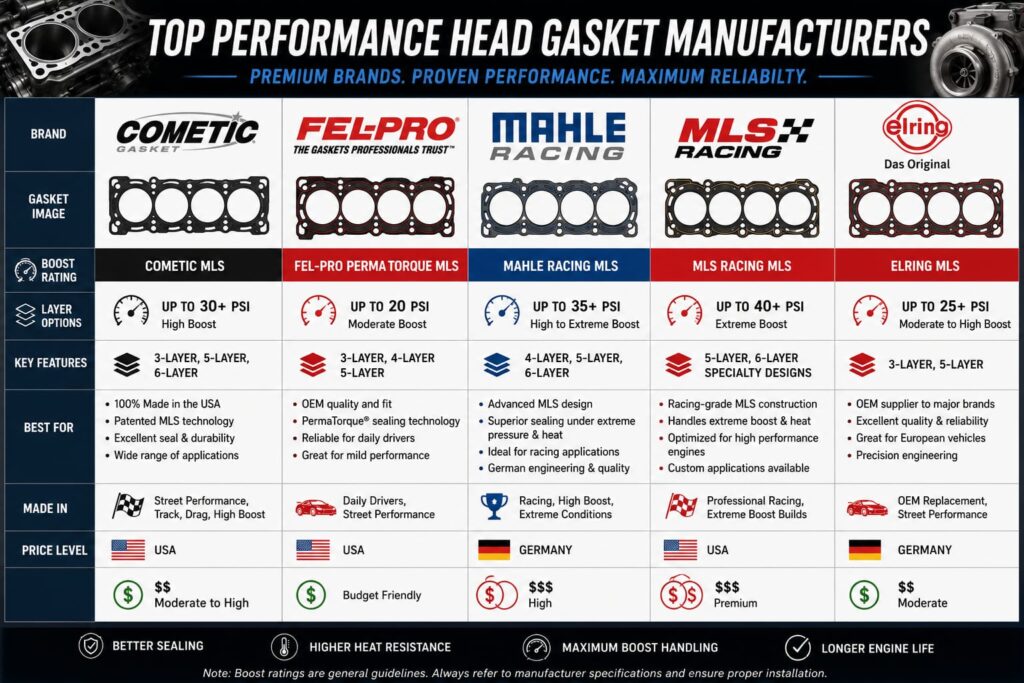
See our comprehensive sub-post for detailed gasket types and construction: [PILLAR LINK: MLS Head Gasket Types and Materials]
Top Performance Head Gasket Brands for Boost
Several manufacturers specialize in performance gaskets designed specifically for forced induction engines. Here’s an overview of the top choices for serious builds:
Cometic Gaskets
Cometic is THE performance gasket brand for custom builds and racing. They offer multi-thickness options, custom bore sizing for overbored or sleeved engines, and explicitly rated boost limits. Cometic’s ultra-high-temperature Flourotripolymer coating handles extreme conditions. For any modified engine, Cometic offers a solution.
Fel-Pro / Federal-Mogul
Fel-Pro’s PermaTorque line includes performance variants designed for modified engines. Their Fiber Armor coating provides excellent conformability even on imperfect surfaces, important in high-mileage cores being re-ringed. Available in multiple thicknesses for compression ratio tuning.
MLS Racing (OEM Racing Departments)
Many OEM manufacturers (Mahle for GM, Porsche, BMW; Elring for Mercedes and VW) produce racing-grade variants available through racing suppliers. These are often developed directly from factory racing teams’ experience.
Specialty Racing Suppliers
Engine builders and racing specialists often source gaskets from manufacturers like ARP (known for fasteners and racing components), Probe Racing, and OEM racing divisions. These sources carry bleeding-edge gasket designs not available through standard automotive channels.
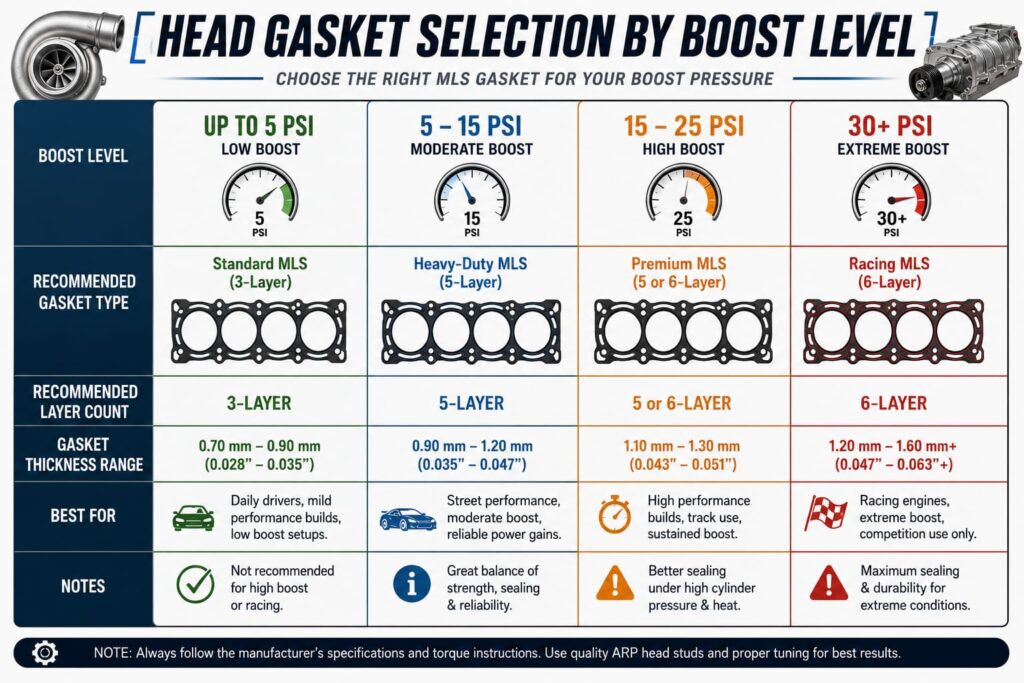
For detailed brand comparison, specs, and sourcing: [PILLAR LINK: MLS Head Gasket Brands & Manufacturers]
Installation Specification for High-Boost Engines
Installing a performance gasket correctly is even more critical than selecting the right one. Here are the specific requirements for modified engines:
Surface Preparation — Non-Negotiable
For performance applications, surface finish spec is tighter than OEM. Require Ra 0.4-0.8 microns (half the OEM tolerance). Measure warpage across the head and block deck in multiple directions — any warpage over 0.02 mm (0.0008″) is unacceptable. Many shops use large precision straightedges and dial indicators for verification. On turbocharged engines, thermal stress concentrates warping risk — professional resurfacing on a CNC head/block machine is highly recommended.
Proper Head Bolt Torque Sequence
Performance engines require strict adherence to the correct torque sequence and values. Use fresh, OEM-specified bolts — never reuse bolts. Apply a light coating of motor oil to bolt threads and washers for accurate tension. Follow the sequence precisely in incremental stages (25%, 50%, 75%, final torque). Many racing teams double-check clamp load using a thread-tension ultrasonic tester for maximum precision.
Compression Ratio Verification
Gasket thickness directly affects compression ratio. When selecting a gasket thickness for a modified engine, calculate the resulting compression ratio and verify it matches your fuel octane rating and boost level. High compression (12:1+) with high boost requires premium fuel and strong detonation control. Undersized compression ratio wastes horsepower potential.
High-Performance Gasket FAQ
Q: How much boost can a standard OEM MLS head gasket handle safely?
A: Most OEM gaskets are rated to handle up to 12-15 PSI safely. Beyond that, seek performance-grade gaskets. For continuous operation over 20 PSI, 5+ layer racing-spec gaskets are essential.
Q: Will a performance gasket help me avoid head gasket failure on my turbocharged daily driver?
A: Yes, absolutely. Upgrading from OEM to a heavier-duty performance gasket is one of the best reliability modifications for forced-induction street cars. It buys you margin against detonation and heat stress.
Q: Can I reuse a copper head gasket?
A: Yes, this is a key advantage of copper. After a failure, the gasket can be removed, the surfaces re-cleaned, and the same gasket re-installed. However, the engine surfaces must meet stricter tolerances than with MLS.
Q: What’s the difference between a 5-layer and 6-layer racing gasket?
A: An additional layer increases sealing redundancy and allows finer control of clamp load distribution. For ultra-high-boost racing applications (500+ PSI), that extra layer matters. For street cars, 5-layer is typically sufficient.
Q: Do performance gaskets require gasket sealant?
A: No. Modern MLS gaskets should be installed dry. Never use gasket maker, sealant, or spray on MLS head gaskets unless specifically instructed by the manufacturer for a particular application.
Conclusion: Performance Gaskets for Extreme Builds
High-performance head gaskets are not luxury upgrades — they are essential engineering components for any forced-induction or high-compression engine. The difference between the right gasket and the wrong one can be the difference between 500+ reliable horsepower and a blown engine on the first full-boost acceleration.
Whether you’re building a street turbo for weekend thrills, a competition drag car, or a track-focused race machine, investing in properly-engineered performance gaskets and installing them correctly is one of the highest ROI modifications you can make.
Explore all our performance engine resources:
- [PILLAR LINK: MLS Head Gasket Complete guide]
- How many gaskets and components are in your engine?[PILLAR LINK: How Many Gaskets Does a Car Have?]