
Is a Blown Head Gasket Worth Fixing?
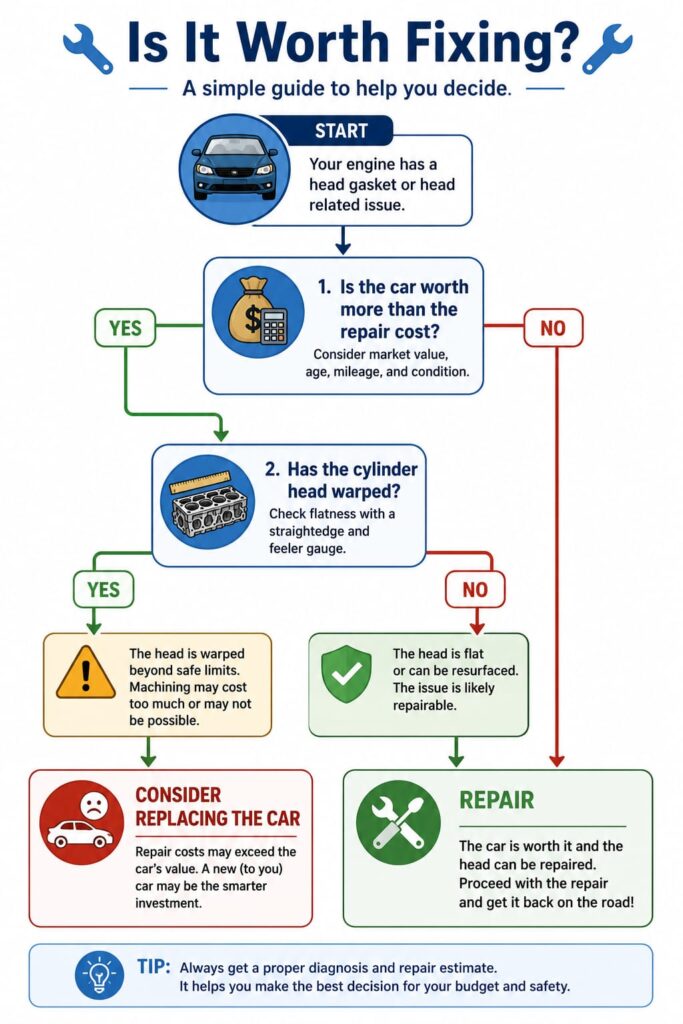
There’s a specific kind of dread that comes with a mechanic saying the words “blown head gasket.” You already sense it’s going to be expensive, and now you’re stuck making a decision about a car you may have driven for years, based on a repair estimate you don’t fully understand. Before you sign off on anything — or decide to walk away from the car entirely — it’s worth slowing down and actually running the numbers, because the right answer really does depend on your specific situation.
This post is part of our complete guide on head gasket repair costs and timelines — see the full breakdown for all repair scenarios below.
“complete head gasket repair guide”
The Short Answer
In most cases, fixing a blown head gasket is worth it if your car is otherwise reliable, the damage is limited to the gasket itself, and the repair cost stays under roughly half of what the car is worth on the used market. Once the repair cost creeps past that point, or once other components are found to be damaged too, the math starts to shift in favor of moving on to a different vehicle.
That’s the short version. The rest of this comes down to understanding why the repair costs what it does, and how to weigh your specific situation against it.
The Simple Rule of Thumb Mechanics Use
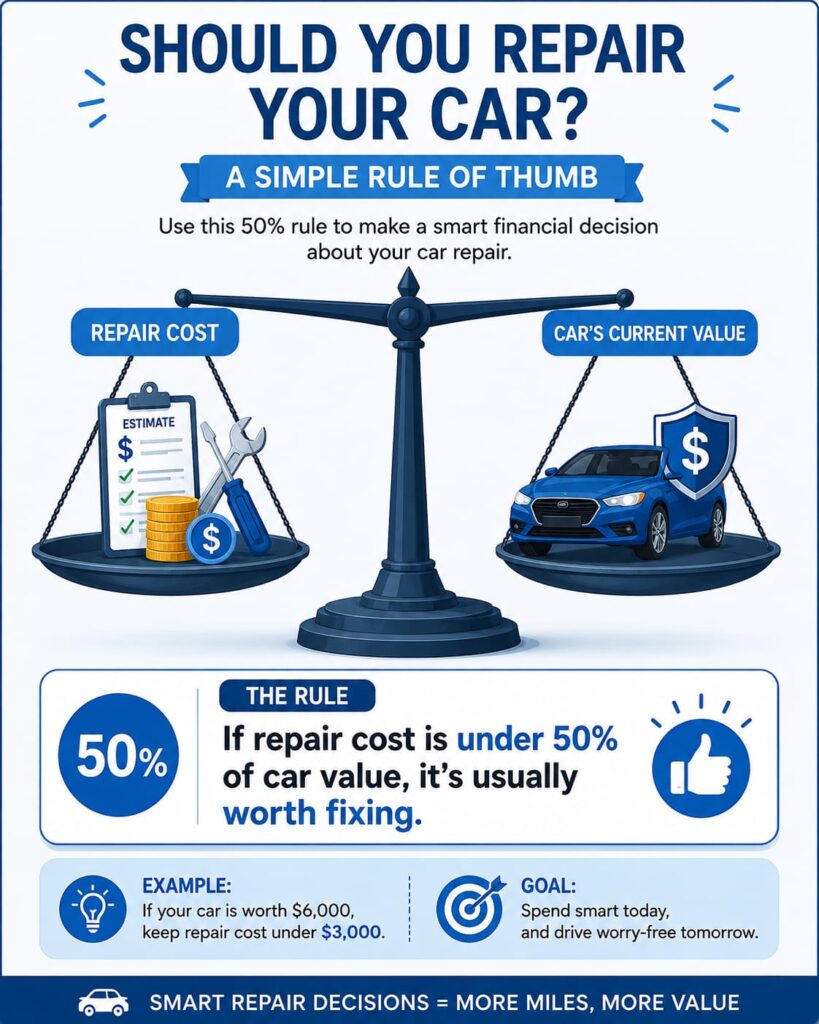
Ask ten experienced mechanics how they’d advise a customer in this situation, and most of them will give you some version of the same rule: compare the total repair cost to the car’s current resale value, not what you paid for it originally or what you think it’s worth sentimentally.
Look up your car’s private-party or trade-in value using a tool like Kelley Blue Book or Edmunds before you make any decision. If the repair estimate is less than about 50% of that number, most mechanics would tell you it’s a reasonable repair. If it’s close to or exceeds that number, you’re essentially paying to keep an older car on the road at close to its own market value — money that might be better put toward a different vehicle with fewer question marks.
Why Head Gasket Repair Costs So Much in the First Place
One of the most common questions people ask right after getting a quote is why a single gasket — a thin, relatively inexpensive part — costs so much to replace. The part itself is rarely the expensive piece. What drives the cost is the labor required to reach it.
To replace a head gasket, a mechanic typically has to remove the intake manifold, exhaust manifold, timing belt or chain, valve covers, and the cylinder head itself, then carefully clean every mating surface before reassembly. On some engines, this teardown alone eats up the better part of a full working day before the actual gasket replacement even happens.
This is also why the same repair costs noticeably different amounts depending on the engine layout. A simple inline-4 engine, where the cylinder head sits right on top and is easy to access, is usually the cheapest version of this repair. A V6, V8, or horizontally-opposed boxer engine — where there are two cylinder heads, or where components are stacked in a way that requires more disassembly — pushes the labor time, and therefore the cost, noticeably higher.
Factors That Tip the Decision Toward ‘Fix It’
- The car is mechanically sound otherwise — no major transmission, suspension, or electrical issues waiting in the wings
- Only the head gasket has failed, with no warping or cracking found in the cylinder head itself
- The car has genuine value to you: it’s paid off, it’s reliable, or it would be difficult or expensive to replace with something equally dependable
- You caught the problem early and confirmed it with proper testing, rather than driving on it for weeks with a warning light ignored
- The repair estimate comfortably falls under half the car’s current resale value
Factors That Tip the Decision Toward ‘Let It Go’
- The car already has other expensive problems competing for the same repair budget
- The cylinder head is warped or cracked, turning a moderate repair into a much larger one
- The vehicle has very high mileage, and other major components (timing components, suspension bushings, etc.) are likely due soon regardless
- The repair estimate approaches or exceeds half of what the car is actually worth used
- You’ve had repeated cooling system or overheating issues before this, suggesting an underlying problem that could cause a repeat failure
A Real-World Way to Run the Numbers
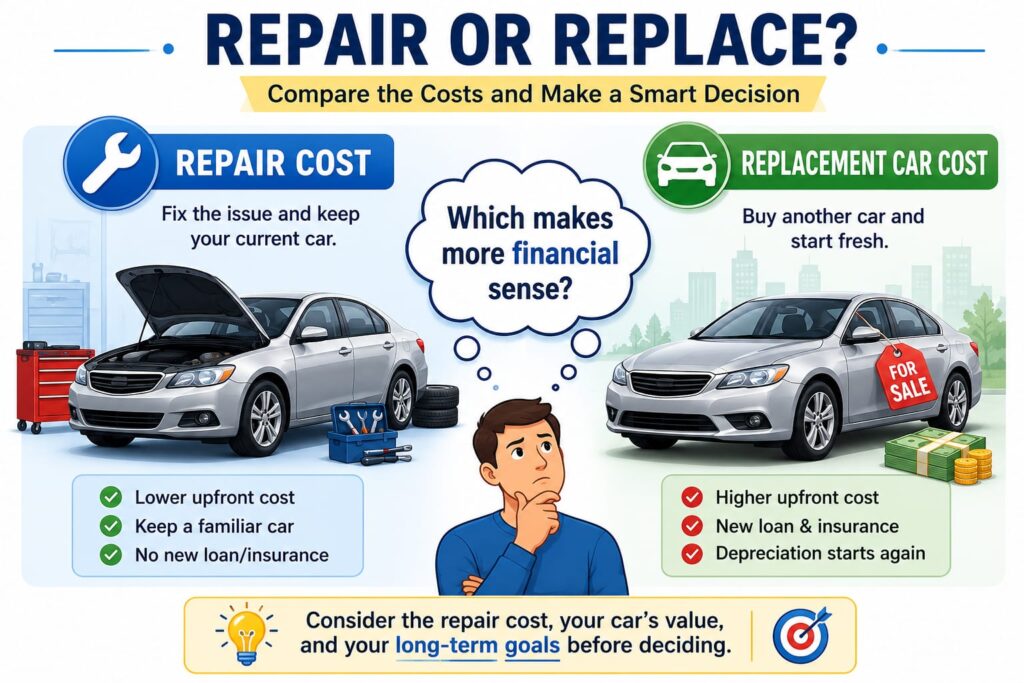
Rather than deciding based on gut feeling, it helps to write the actual numbers down side by side. Compare your total repair estimate against your car’s realistic private-sale value (not the inflated number a dealer trade-in calculator sometimes shows). If you’re on the fence, it’s also worth getting a rough estimate for what a comparable used replacement car — similar age, mileage, and condition — would cost you. Sometimes that comparison makes the decision obvious in a way that staring at a single repair bill doesn’t.
| Usually Worth Fixing | Usually Not Worth Fixing |
| Gasket-only failure, no warped head | Warped or cracked cylinder head found |
| Repair cost under ~50% of car’s value | Repair cost near or over car’s value |
| Car is otherwise mechanically healthy | Other major repairs already needed |
| Caught early, confirmed by proper testing | Driven for a long time while overheating |
What About Repairing It Yourself?
If you’re mechanically inclined, a DIY head gasket repair can cut the cost significantly, since labor is the main expense in this job. That said, this isn’t a beginner-friendly repair. It requires a torque wrench and the exact tightening sequence for your engine, patience for careful reassembly, and ideally a way to check the cylinder head for warping before you put everything back together. Getting the reassembly wrong — especially torque sequence and specification — can cause a repeat failure almost immediately, so this is a project best suited to someone with prior engine work experience rather than a first-time repair.
Getting a Second Opinion Before You Decide
Because this repair involves some judgment calls — like whether the cylinder head needs machining or full replacement — it’s worth getting a second quote if the first one feels unusually high, especially if it’s a large national chain rather than an independent shop with more incentive to build long-term trust. A second inspection sometimes finds that only the gasket needs attention, not the full head, which can meaningfully change your decision.
Frequently Asked Questions
Is it ever better to just replace the engine instead of the gasket?
In some cases, yes. If the head gasket failure caused extensive internal damage — like a cracked block — a used or remanufactured engine swap can end up costing about the same as an extensive head gasket repair, while giving you more certainty about the engine’s overall condition going forward.
Can I sell a car with a blown head gasket instead of repairing it?
Yes. There’s a market of buyers who specifically look for cars with known, fixable mechanical problems at a discounted price. You’ll get less than you would for a running car, but it lets you avoid the repair cost and the uncertainty entirely.
Does a blown head gasket always mean the engine is ruined?
No. Many blown head gaskets are caught and repaired without any lasting damage to the engine, especially when addressed promptly rather than driven on for an extended period.
How do I know if it’s really the head gasket and not something else?
Don’t rely on symptoms alone. Proper testing — like a compression test, leak-down test, or chemical block test — confirms the diagnosis before you spend money on a repair, since several other issues can mimic head gasket symptoms.
[LINK: How to Test for a Blown Head Gasket -> confirm the diagnosis before repairing]