
One of the easiest and most reliable home tests for a blown head gasket is checking your engine oil. When coolant mixes with engine oil, it creates a distinctive white, milky appearance that’s nearly impossible to miss. This test costs nothing, takes minutes, and can give you immediate answers about your vehicle’s condition.
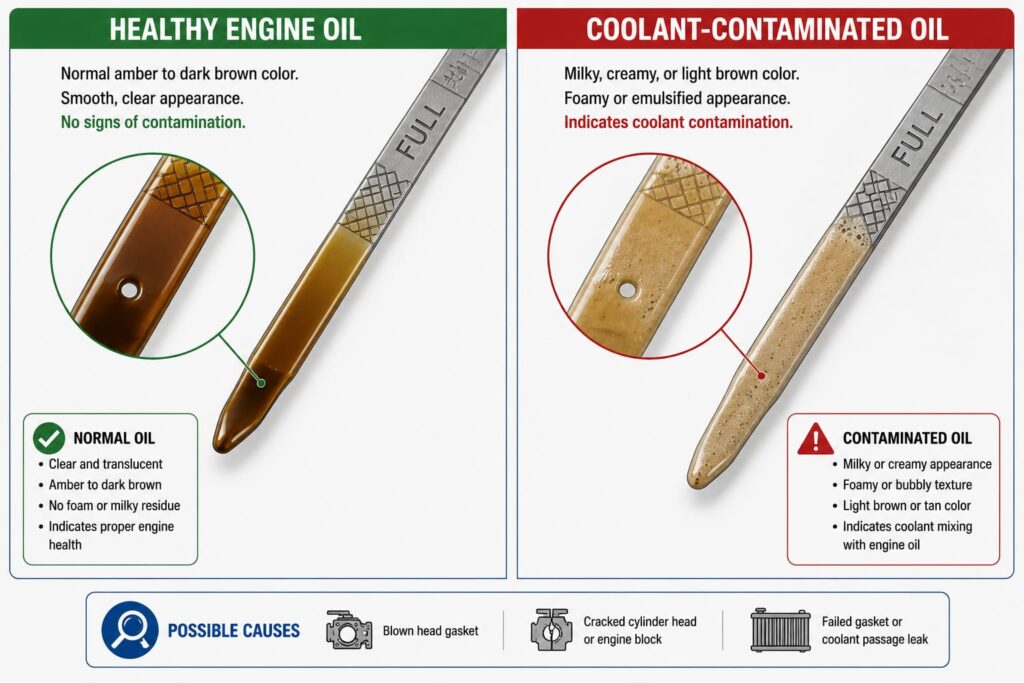
Why the Oil Turns Milky
The head gasket is the seal between your engine block and cylinder head. When it fails, the coolant system and oil system can communicate with each other—something that should never happen. Coolant is water-based and lighter than oil. When it enters the crankcase, it floats to the surface, creating that characteristic milky, foamy appearance.
Tools You’ll Need
The beauty of this test is its simplicity. You only need:
• Engine Dipstick (your vehicle’s standard dipstick)
• Clean Rag or Paper Towel (to wipe the dipstick)
• Clear Container (optional, but helpful for inspection)
• Level, Safe Parking Area (engine must be cool)
Step-by-Step Procedure
Step 1: Park and Cool Down
Park your vehicle on a level surface and allow the engine to cool completely. This typically takes 30-45 minutes after running. A hot engine can produce misleading results, and you risk burns from hot oil.
Step 2: Open the Hood
Locate the dipstick under your hood. Consult your owner’s manual if you’re unsure where it is. Most vehicles have a bright yellow or orange T-shaped handle.
Step 3: Remove and Wipe the Dipstick
Pull the dipstick straight out. Wipe it completely clean with a rag, removing all oil residue. This gives you a clean baseline for inspection.
Step 4: Reinsert and Withdraw
Push the dipstick back in fully, then pull it out again. This fresh sample is what you’ll inspect.
Step 5: Inspect the Oil
Look carefully at the oil on the dipstick. Normal engine oil appears dark brown or black and transparent. If you see a milky white, cream-colored, or frothy appearance, that indicates coolant contamination. Pour a small amount into a clear container to see the color more clearly.
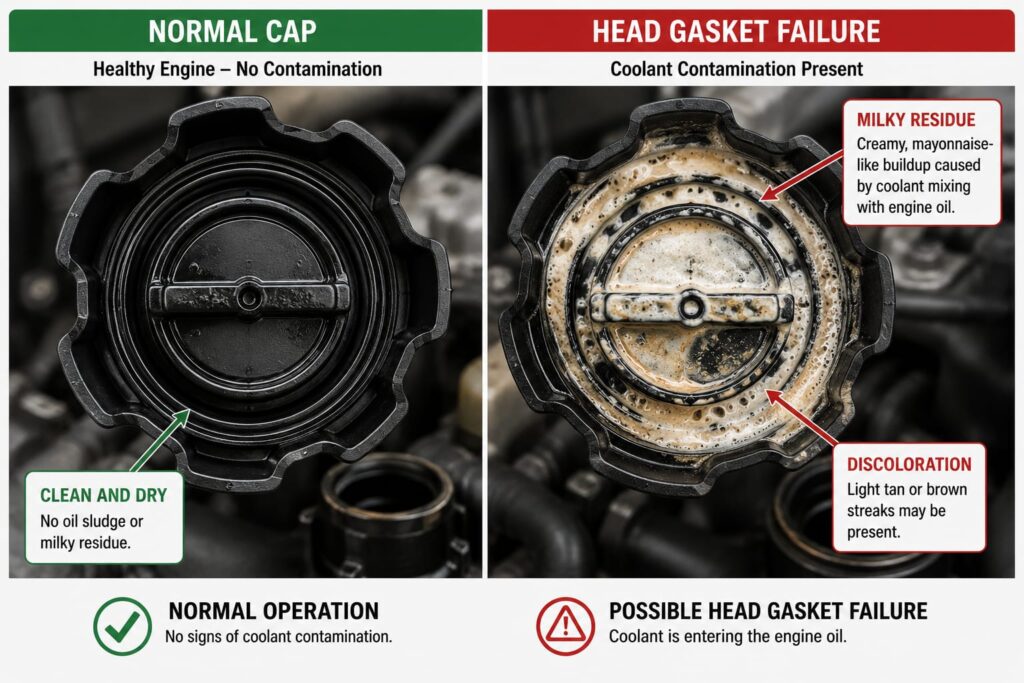
What the Results Mean
Clear Brown/Black Oil: Your oil is healthy. No head gasket failure.
Milky White or Cream-Colored Oil: Strong indicator of coolant in the crankcase. Head gasket failure is likely.
White Foam or Froth: Coolant is definitely present. Seek professional diagnosis immediately.
Advantages of the White Milky Oil Test
✅ Completely Free: No tools or equipment to purchase
✅ Quick: Takes 5-10 minutes from start to finish
✅ Safe: No mechanical work required
✅ Visual Confirmation: The evidence is right there on the dipstick
✅ Repeatable: You can check again to monitor changes
Limitations of This Test
❌ Not Always Definitive: In early-stage gasket failure, coolant mixing may be minimal and hard to detect
❌ Other Causes: Moisture can occasionally enter oil through condensation, though this is rare
❌ Doesn’t Show Location: This test confirms the problem but doesn’t tell you where the leak is
❌ Recent Short Drives: If the engine hasn’t run long enough, mixing may not be obvious
Cost and Time Estimate
Material Cost: $0 (free—you likely have all materials at home)
Time Required: 5-10 minutes
Overall Cost: Nothing
Next Steps After Finding Milky Oil
If you confirm milky oil in your engine, don’t panic—but do act. Driving on a blown head gasket accelerates damage. Consider these next steps:
1. Stop driving the vehicle unnecessarily
2. Perform one or more of the other diagnostic tests (compression test, leak-down test, pressure test)
3. Get a professional mechanic’s assessment
4. Budget for head gasket replacement (typically $500-2,500)
FAQ
Q: Can condensation cause milky oil without head gasket failure?
A: Rarely. Condensation might create a slightly hazy appearance on the dipstick stick itself, but genuine milky oil mixing throughout the crankcase is a strong indicator of head gasket issues.
Q: My oil looks slightly cloudy but not fully white. Should I worry?
A: Yes, this warrants further investigation. Perform the compression test or pressure test for confirmation. Early-stage gasket failure can show subtle signs.
Conclusion
The white milky oil test is your first line of defense in diagnosing head gasket problems. It’s free, fast, and surprisingly accurate. If you see white, milky oil on your dipstick, trust your eyes—you likely have a blown head gasket. The next step is confirming the diagnosis with more advanced tests before scheduling expensive repairs.
Want more certainty? Proceed to the [PILLAR LINK: How to Test a Blown Head Gasket – Complete Guide] to explore 7 other diagnostic methods.