
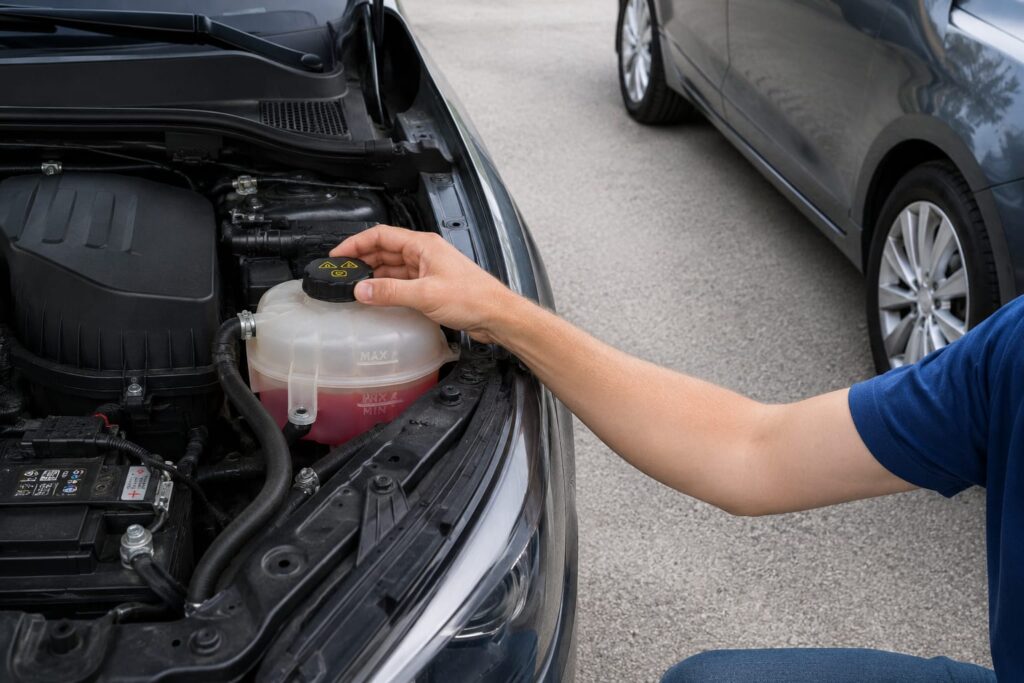
Topping off the coolant reservoir every week or two, checking under the car, and finding nothing — no drips, no wet spots, no crusty white or pink residue near hoses or the radiator — is a specific kind of frustrating. The instinct is to assume there’s no real problem since there’s no visible mess, but coolant that’s actually disappearing has to be going somewhere. When there’s no external leak, that somewhere is almost always inside the engine.
Ruling Out an External Leak First
Before assuming an internal problem, it’s worth doing a careful check for external leaks that aren’t always obvious at a glance. Small leaks from a hose clamp, a heater core, or a water pump seal can sometimes evaporate quickly enough on a hot engine that they don’t leave a puddle, especially in dry climates. Checking hose connections, the water pump weep hole, and the radiator seams closely — including with a flashlight — rules this out before moving on to internal causes.
Where the Coolant Actually Goes
Once an external leak is ruled out, coolant disappearing internally usually ends up in one of two places. It can burn off inside a cylinder, which is what produces the white or blue-white exhaust smoke that people associate with a head gasket problem. Or it can mix into the engine oil, producing the milky, mayonnaise-like residue on the dipstick that’s one of the more visually obvious head gasket symptoms. In both cases, a failed head gasket — or in some cases a cracked cylinder head — is typically the path that’s letting coolant cross into a space it shouldn’t be.
Why This Symptom Is Easy to Dismiss
Because there’s nothing dramatic to see — no smoke cloud, no milky oil yet, no warning light — it’s tempting to keep topping off the reservoir indefinitely and assume it’s a minor, manageable issue. But a head gasket that’s slowly letting coolant escape internally tends to get worse over time rather than staying stable, and by the time more obvious symptoms show up, the leak may have progressed further than it would have if caught earlier.
How to Confirm What’s Happening
A chemical block test on the coolant can detect combustion byproducts even before visible smoke shows up, making it one of the earliest ways to catch a developing gasket leak. Checking the oil dipstick regularly for any early discoloration, and watching the tailpipe on a cold start and after the engine’s fully warmed up, can also catch the problem before it becomes more obvious — and more expensive.
What to Do Next
Treat unexplained coolant loss as a real warning sign rather than something to keep topping off indefinitely. Getting a block test done while the symptom is still mild — before smoke or milky oil shows up — often means catching a gasket problem at its earliest and least expensive stage.
Full breakdown: see our Blown Head Gasket guide for the complete list of related symptoms, causes, and next steps.