
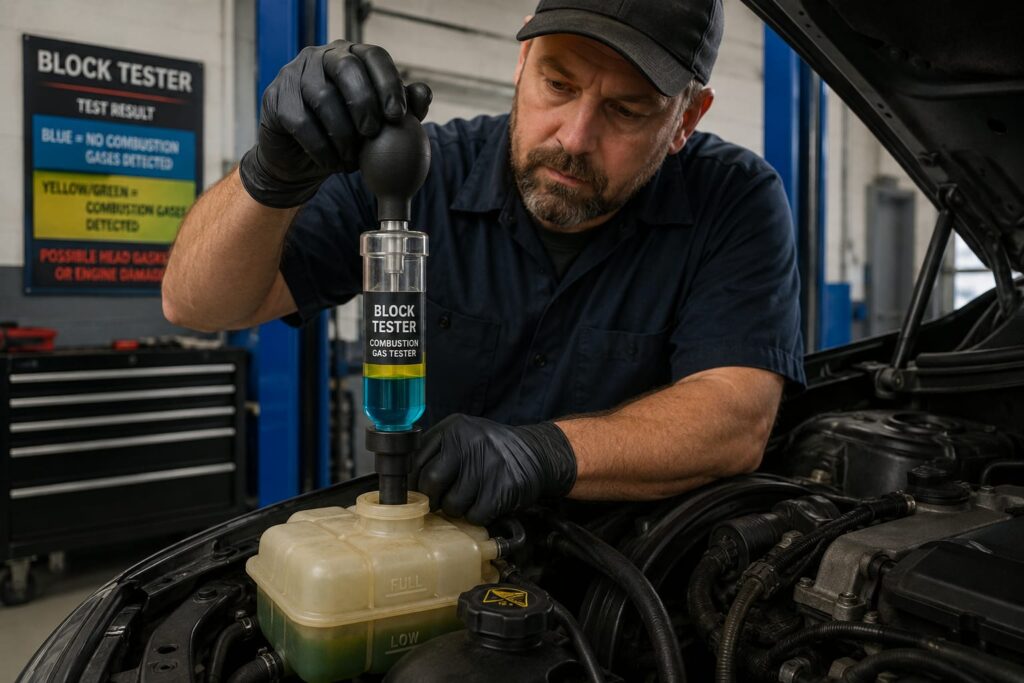
Matching your symptoms to a blown head gasket is a useful starting point, but symptoms alone can point to several different problems — a cracked head, a failing water pump, or a different gasket entirely can all mimic parts of the picture. Confirming the diagnosis before committing to a repair means using one or more of a few reliable tests, each of which checks for a different kind of evidence.
The Chemical Block Test
This is usually the fastest and most common first test. A block tester uses a chemical fluid that changes color when it detects combustion byproducts — specifically carbon dioxide — in the coolant. The tool sits above the radiator or coolant reservoir opening while air is drawn through it from the cooling system. If the fluid changes color, combustion gas is present in the cooling system, which is strong evidence of a gasket breach between a cylinder and a coolant passage. This test typically takes only a few minutes and doesn’t require removing any major components.
The Cooling System Pressure Test
A pressure tester attaches to the radiator or reservoir opening in place of the cap and pressurizes the cooling system to a specified level. If the system can’t hold pressure and it’s not from an external leak, that points toward an internal leak — often the head gasket, though a cracked head or heater core can also be responsible. This test is also useful for catching external leaks (hoses, the radiator, the water pump) that might be contributing to symptoms alongside or instead of a gasket problem.
The Compression Test
A compression test measures how much pressure each cylinder builds during its compression stroke. If a head gasket has failed between two adjacent cylinders, both of those cylinders often show unusually low or uneven compression compared to the others, since pressure is escaping between them rather than staying contained. This test is particularly useful when combined with a rough idle or misfire that seems localized to one part of the engine.
The Leak-Down Test
A leak-down test goes a step further than a compression test by holding a cylinder at top dead center and measuring how quickly compressed air escapes it. Where that air ends up — bubbling into the cooling system, hissing out through the intake, exiting through the exhaust, or leaking into an adjacent cylinder — tells a mechanic specifically what kind of failure is happening and where, which a compression test alone can’t fully distinguish.
Reading the Results Together
No single test is considered fully conclusive on its own in every situation, which is why mechanics often combine two or more. A positive block test alongside low or uneven compression on adjacent cylinders is about as clear a confirmation as you can get without removing the head entirely. If results are inconsistent or ambiguous, removing the head for a direct visual inspection is the most definitive way to see the exact location and extent of the failure.
What This Means for Your Repair Cost
A confirmed diagnosis before repair matters because it prevents paying for the wrong fix — replacing a water pump when the actual problem is the gasket, for example, or replacing a gasket when the head itself is cracked and needs separate attention. Testing upfront, even though it adds a small cost, generally saves money by avoiding repeat repairs.
What to Do Next
If you’ve matched several symptoms and want to confirm the diagnosis, a shop can typically run a block test and compression test in the same visit for a reasonably quick answer. Once the diagnosis is confirmed, the next step is deciding on repair scope and cost.
Full breakdown: see our Blown Head Gasket guide for the complete list of related symptoms, causes, and next steps.