
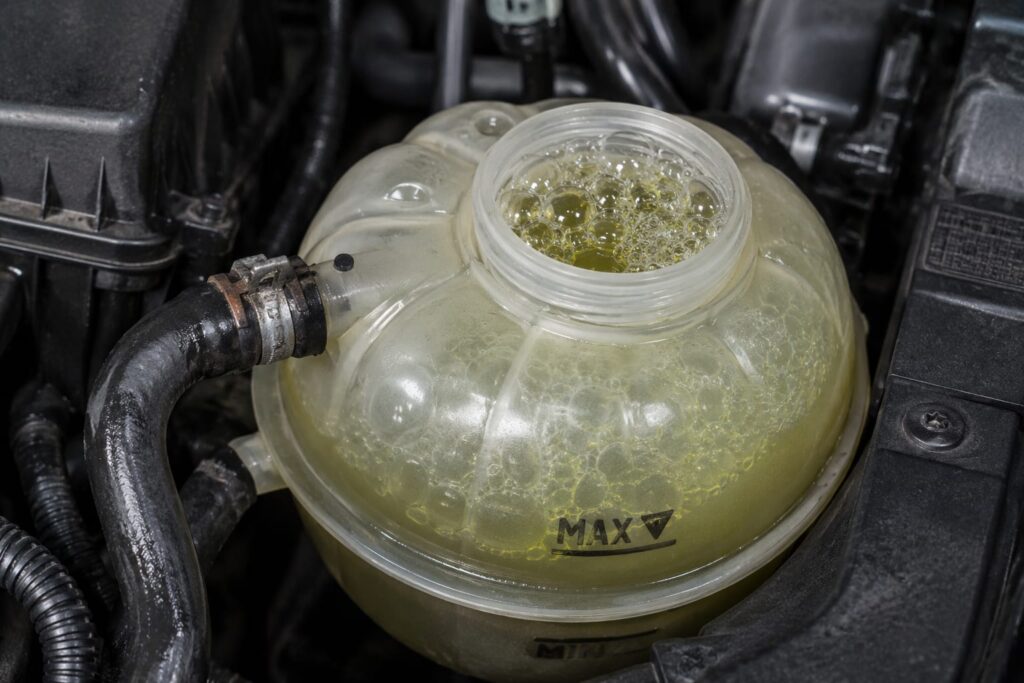
Of all the ways to check for a head gasket problem, watching the coolant reservoir is one of the simplest — no tools required, just your eyes and a few minutes with the engine running. If you’ve noticed bubbling in there, it’s worth understanding what it means before jumping to conclusions, since not all bubbling points to the same problem.
What Causes Bubbling in the Reservoir
Under normal operation, coolant should flow smoothly with at most a very gentle circulation visible at the surface. Persistent bubbling — especially bubbling that gets more pronounced when you rev the engine — usually means combustion gas is escaping into the cooling system through a breach in the head gasket, most often around a cylinder. That gas works its way through the cooling passages and rises up through the reservoir as bubbles, essentially the cooling system being pressurized by something it was never designed to handle.
How to Do the Test Safely
This test should only be done on a cool or warm engine — never a hot one. Removing a radiator cap or reservoir cap on a hot, pressurized cooling system can cause scalding coolant to spray out, which is a real burn risk. With the engine cool or only mildly warm, remove the cap, start the engine, and let it idle while you watch the fluid level. Gently revving the engine a few times while watching for a corresponding increase in bubbling can help confirm what you’re seeing.
If you’re not confident doing this safely, it’s better left to a mechanic, who can pair the visual check with a proper chemical block test for a more reliable result.
Bubbling vs. Normal Coolant Flow
It helps to know what normal looks like first. A healthy cooling system can show some gentle movement or very light circulation at the reservoir surface, especially right after startup. What you’re looking for is a difference in degree — actual bubbles rising steadily, particularly ones that increase noticeably when the engine is revved rather than staying constant regardless of engine speed.
What a Positive Result Means
Consistent bubbling that tracks with engine speed is a strong indicator of a head gasket breach between a cylinder and a coolant passage. It doesn’t tell you the exact location or severity of the failure on its own, but combined with a chemical block test — which detects combustion byproducts in the coolant directly — it’s usually enough to confirm the diagnosis without needing to remove the cylinder head.
What to Check Alongside This Test
Bubbling on its own is a useful clue but rarely the only sign. It’s worth also checking for white or blue-white exhaust smoke, milky residue on the oil dipstick, a rising temperature gauge, or coolant that keeps disappearing with no puddle underneath the car — any combination of these alongside bubbling makes the diagnosis more confident.
What to Do Next
If you’ve confirmed bubbling that tracks with engine speed, avoid extended driving and get a proper block test done to confirm the diagnosis before committing to a repair. Guessing based on the reservoir alone, without confirming the source, can lead to replacing the wrong component.
Full breakdown: see our Blown Head Gasket guide for the complete list of related symptoms, causes, and next steps.