
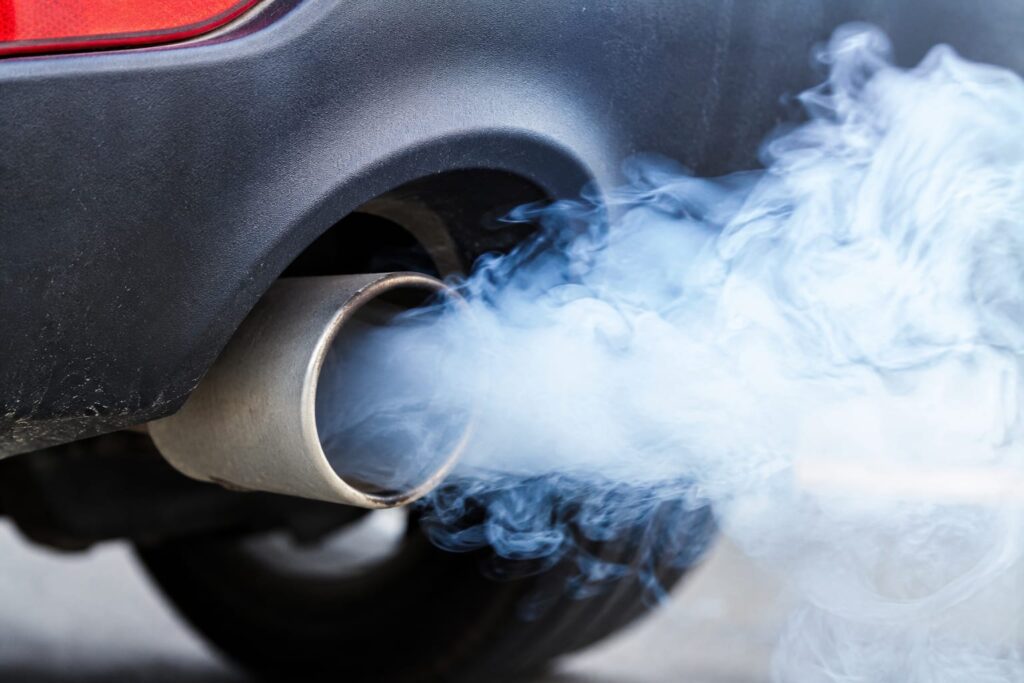
You pull out of the driveway, glance in the rearview mirror, and there it is — a cloud of smoke trailing behind you that definitely wasn’t there last week. Before you assume the worst, it helps to know that not all exhaust smoke means the same thing. The color, thickness, and timing of the smoke all point toward different problems, and getting the diagnosis right saves you from paying for the wrong repair.
This guide breaks down what white and blue-white smoke specifically mean, how to tell it apart from ordinary condensation, and when it’s a sign of something more serious going on inside the engine.
Normal Condensation vs. an Actual Problem
Almost every car will puff a small amount of white vapor out the tailpipe on a cold morning. That’s just moisture in the exhaust system condensing and burning off as the engine warms up, and it’s completely normal. The giveaway that it’s harmless is timing: it shows up in the first minute or two of driving and disappears entirely once the engine reaches operating temperature.
What separates a real problem from that normal puff is persistence. If the smoke is still there five, ten, or twenty minutes into your drive — especially once the engine is fully warmed up — that’s no longer condensation. Something is burning inside the engine that shouldn’t be there.
What Causes Persistent White or Blue-White Smoke
Thick white smoke that keeps coming after the engine is warm is typically coolant finding its way into a combustion chamber and burning off along with the fuel. A few paths lead to this:
A head gasket seal that has failed between a coolant passage and a cylinder is one of the most common causes, since it creates a direct route for coolant to enter the combustion chamber under pressure.
A cracked cylinder head or cracked engine block can create a similar path for coolant, even with the gasket itself intact.
A cracked intake manifold, on some engine layouts, can also let coolant reach a cylinder without any gasket or head damage at all.
The smoke often gets noticeably thicker under acceleration, since that’s when more coolant is being pulled into the combustion process at once.
How to Tell Coolant Smoke Apart From Oil Smoke
Color is a starting point but not a perfect test on its own — both coolant and oil can produce smoke that looks pale under certain lighting. A few other clues help narrow it down. Coolant-burning smoke tends to be a cleaner, more uniform white and often carries a faint sweet smell, since most coolant contains ethylene glycol, which smells sweet when burned. Oil-burning smoke is more often described as blue-gray, tends to look a bit thicker or oilier in texture, and smells sharper and more acrid rather than sweet.
Checking the coolant reservoir level and the oil dipstick right after noticing the smoke is one of the fastest ways to confirm which fluid is involved — a coolant level that’s dropped with no visible external leak points strongly toward coolant being the culprit.
Other Symptoms That Usually Show Up Alongside It
Persistent white smoke rarely shows up completely on its own when a head gasket is involved. It’s worth checking for a few other signs at the same time: a rising temperature gauge, milky or discolored residue on the oil dipstick, coolant that keeps disappearing with no puddle underneath the car, or bubbling in the coolant reservoir when the engine is idling with the cap off.
What to Do Next
If the smoke is persistent rather than a brief cold-morning puff, avoid long drives until it’s checked. A block test or chemical combustion leak test can confirm within minutes whether combustion gas is present in the cooling system, which is one of the most reliable ways to verify a head gasket problem rather than guessing from the smoke alone.
Full breakdown: see our Blown Head Gasket guide for the complete list of related symptoms, causes, and next steps.